



CLA News / What to Expect in Anti-Money Laundering Regulation for the Legal Sector in 2026 by Prosper Simbarashe Maguchu

Introduction
On the first of January, The Guardian ran an article titled “UK law firms get ready for crackdown on money laundering,” with the subheading noting harsher penalties and a reshaping of the sector as the Financial Conduct Authority (FCA) assumes responsibility as the new anti-money laundering regulator for the legal profession.
This development points towards a decisive regulatory turning point, suggesting that 2026 will usher in a new era of heightened scrutiny and enforcement. The FCA’s designation as the AML watchdog for the legal sector is expected to lead to stricter supervision, greater regulatory consistency, and more robust enforcement. It also signals a shift towards treating money laundering risks in the legal profession with the same seriousness applied to the financial sector.
An observant reader will appreciate that these changes are unlikely to remain confined to the United Kingdom. Given the UK’s historical influence on common law systems, regulatory reforms introduced in London often find their way, directly or indirectly, into Commonwealth jurisdictions.
AML Regulation and the Legal Profession
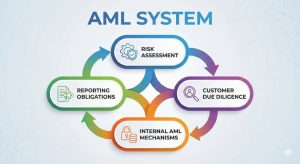
For those still grappling with the subject, AML obligations for the legal profession can be understood through four core and interlinked elements: risk assessment, customer due diligence (CDD), internal mechanisms, and reporting obligations. They stem from the controversial role played by legal professionals in the laundering of criminal proceeds generated by others, a concern that has preoccupied policy-makers since lawyers were identified as “gatekeepers” capable of blocking or allowing the movement of “dirty” money into the legitimate financial system.
As a result, an array of control measures has been put in place at global, regional, and national levels to prevent legal (and other) professionals from facilitating money laundering. The aforementioned AML elements therefore function as a closed and continuously repeating system, as the figure below illustrates. Together, they form the backbone of modern AML compliance and provide a practical framework for regulatory oversight.
Analytical Context: Structural Drivers of Change in AML Regulation for the Legal Profession
Against this background, three closely related developments provide a useful analytical lens for anticipating how recent regulatory shifts in the UK are likely to reverberate across other Commonwealth jurisdictions in 2026. Each development is mutually reinforcing, collectively signalling a trajectory towards a more exacting and interventionist compliance environment for the legal profession.
First, the UK has long acted as a global trendsetter in the regulation of the legal profession, particularly in the area of anti-money laundering. Many common law jurisdictions traditionally look to UK standards when shaping their own regulatory frameworks. The UK has effectively “gold-plated” AML obligations for independent legal practitioners, thereby offering a practical template for compliance with Financial Action Task Force (FATF) standards. As these standards are framed as international best practice, their adoption elsewhere is both convenient and politically defensible for regulators.
Second, the internationalisation of British law firms is an important development to consider. This is closely intertwined with the global appetite for English law in commercial and financial transactions, which continues to anchor UK firms at the centre of international legal practice. UK-based firms, in particular, maintain extensive global connections that will inevitably be affected by heightened AML expectations. UK law firms operate through a variety of cross-border arrangements, meaning that regulatory expectations applied in the UK may have implications for connected firms across multiple jurisdictions.
Moreover, the internationalisation of law firms has been the subject of sustained academic study. Although the precise typologies of international legal practice remain only partially defined, empirical research provides useful insights. One study, focusing on the network dependency of European law firms, analyses and summarises their structural and governance tendencies and develops a typology of distinct international peer networks. This body of research illustrates that the internationalisation of law firms is not merely symbolic but structural. These connections take multiple forms, including regional and global networks or alliances, ranging from arrangements that involve shared branding, benefits, and talent, to looser groups of independent law firms that collaborate on a non-exclusive basis.
Third, at the international standard-setting level, developments at the level of the FATF are particularly significant and interact directly with the internationalisation of legal practice. Since October 2021, the FATF has adopted minor amendments to Recommendation 23 and the FATF Glossary to clarify how the existing requirements under Recommendation 18 relating to the implementation of group-wide programmes against money laundering and terrorist financing apply to Designated Non-Financial Businesses and Professions (DNFBPs), including legal professionals.
The FATF guidance addresses a critical practical question: what is meant by common ownership, management, or compliance control? Within and across DNFBP sectors, there exists a diverse ecosystem of structures connecting individual entities within broader domestic and international arrangements. Given the lack of uniformity in these structures, the FATF has concluded that it is neither practical nor appropriate to impose standardised rules across all DNFBP sectors. Instead, the FATF encourages jurisdictions to understand the specific structures operating within their legal and professional sectors and to identify those arrangements that, by applying more holistic measures across relevant entities, are better positioned to mitigate money laundering and terrorist financing risks.
Accordingly, the application of group-wide AML/CTF programmes depends on the existence of sufficient connections between entities within a structure to make such programmes feasible. This is particularly relevant for formal networks. Large international legal and accounting firms often operate as networks in which each member firm is independently owned and managed, sometimes through national-level groupings. These firms typically enter into agreements to share a common name, brand, intellectual property, and quality standards. While a global coordinating entity may exist, it usually does not conduct business activities and often neither owns nor directly controls member firms. However, where such networks exhibit common ownership, management, or compliance control, they may be required to apply group-wide AML/CTF programmes to the extent necessary to mitigate identified risks.
The UK Experience and the Possibility of Group-Wide AML Thinking in the Legal Profession
Although the legal profession has not yet developed a fully articulated model of group-wide AML compliance comparable to those found in the financial sector, recent regulatory developments in the UK offer an important point of reference for Commonwealth jurisdictions. In particular, the SRA’s approach to firm-wide risk assessments under the Money Laundering Regulations demonstrates how AML obligations can be conceptualised beyond individual files or offices, and instead applied across the entirety of a legal practice.
The SRA’s guidance on firm-wide risk assessments requires all regulated firms to assess the money-laundering risks to which their whole business is exposed and to document both the methodology used and the mitigation measures adopted. While framed within the UK’s domestic regulatory architecture, the logic underpinning this approach closely mirrors FATF’s risk-based methodology and offers a functional analogue to group-wide compliance thinking. Rather than treating AML as a series of discrete, transaction-level checks, firms are expected to adopt a holistic view of risk that encompasses their organisational structure, client base, services offered, and geographical footprint.
Notably, the guidance places particular emphasis on geographical risk. Firms are required to consider whether they receive referrals from persons or entities based outside the UK, the jurisdictions in which they maintain offices, and the locations in which they provide legal services. For Commonwealth jurisdictions, many of which share legal traditions, professional structures, and regulatory models with the UK this approach is particularly instructive.
Thus, even in the absence of explicit group-wide AML obligations for law firms, the SRA’s firm-wide risk assessment framework could serve as an illustrative example of how law firms can encourage a shift towards enterprise-wide risk awareness and internal controls within their international networks.
Looking ahead
As Kettie Benson observes, “how anti-money laundering is experienced by legal professionals in particular settings will depend on an interaction between the ‘global’ and the ‘local’.” This interaction is neither static nor purely technical; it is shaped by professional culture, institutional design, and enforcement priorities. In 2026, that interaction is likely to intensify. Lawyers across the Commonwealth will increasingly be required to engage with AML compliance as a core professional responsibility rather than a peripheral regulatory requirement attached to financial institutions.
Therefore, preparedness rather than reaction will be the defining measure of compliance maturity. The direction of travel is clear: AML expectations are becoming more integrated, more anticipatory, and more closely aligned with the realities of cross-border legal practice. In this context, the SRA’s firm-wide guidance offers more than domestic regulatory clarification. It provides a template that can inspire more integrated and forward-looking AML regulation across common law systems and beyond, as legal professions brace for the regulatory and enforcement shifts unfolding this year.
Author: Prosper Simbarashe Maguchu
Assistant Professor at Vrije Universiteit, Amsterdam and Head of Training and Professional Development Tsunga Bamu Law International (TBLI) Zimbabwe