

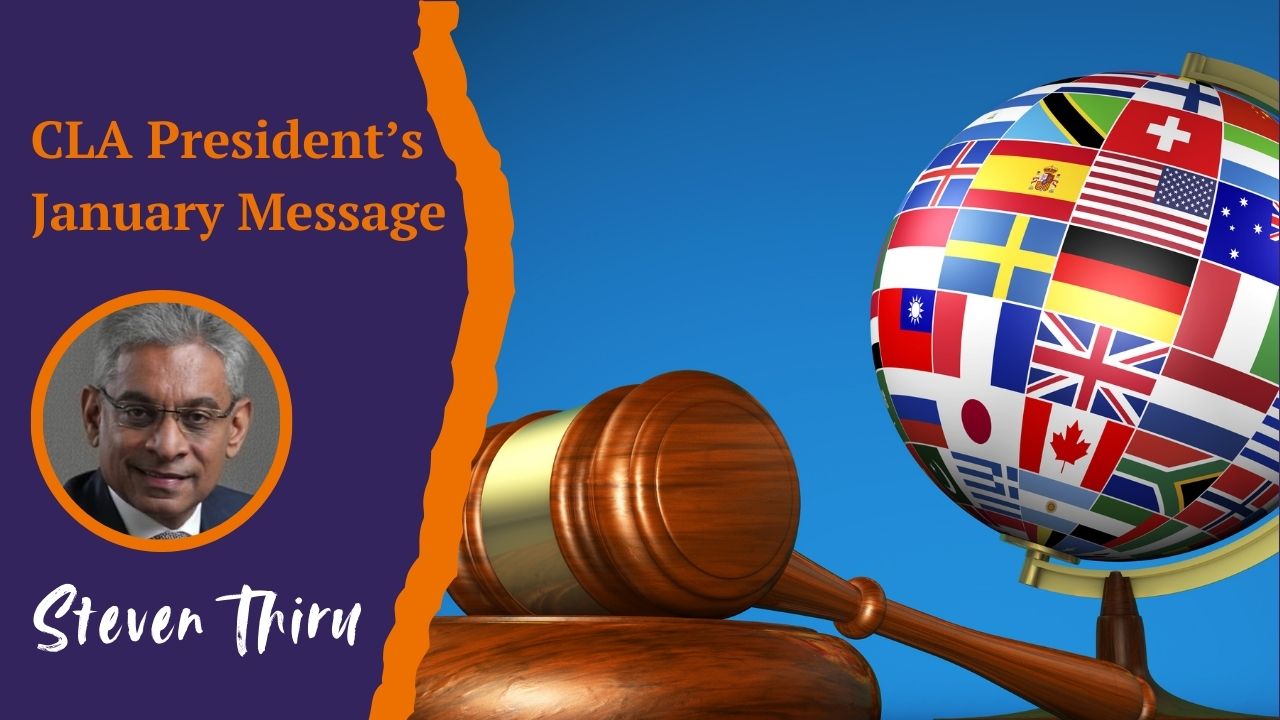
CLA News / CLA President’s January 2026 Message

The Rule of Law Beyond Borders: International Law Still Matters
My own morality. My own mind. It’s the only thing that can stop me. . . . I don’t need international law.
President of the United States, Donald J. Trump (7 January 2026)
Much has already been written about the glaring illegality of the recent armed attack on Venezuela and the forcible rendition of President Nicolás Maduro to the United States. Legal authorities across jurisdictions have raised serious concerns that the operation violated foundational norms of international law, including the prohibition on the use of force under Article 2(4) of the United Nations Charter. That provision forbids military action against the territorial integrity or political independence of another state, absent Security Council authorisation or a legitimate claim of self‑defence.
Protecting International Law Amid Unilateral Action
On 6 January 2026, the CLA issued an open letter addressing our members on the recent United States military actions in Venezuela. The letter was by Sophie Stanbrook, Vice President of the Americas Hub of the CLA and Council Member representing the Turks and Caicos Islands. It was to underscore the urgency of defending the rule of law, sovereignty, and democratic self-determination against unilateral state action, emphasising that lawyers have a particular responsibility in moments when legality is threatened by the abuse of raw power.
The open letter condemns the operations by the United States in Venezuela as abhorrent to the rule of law, emphasising that the use of force against another state’s territorial integrity or political independence is prohibited under the United Nations Charter and regional instruments such as the Inter-American Democratic Charter.
The open letter calls on lawyers and bar associations not to remain silent, but to scrutinise the legality of state conduct, support lawful multilateral processes, and stand in solidarity with colleagues facing pressure or threats, and “resist the idea that legality may be set aside whenever it proves inconvenient”, for “[l]awyers may not decide geopolitical outcomes, but [they] play an essential role in guaranteeing they are not shaped solely by power”.
The International Rule of Law Under Strain
Against this backdrop, a range of legal questions arises. Among the most pressing are the issues of head-of-state immunity and whether a sitting president like Nicolás Maduro could lawfully be stripped of that immunity and subjected to foreign prosecution. International law has long recognised that heads of state enjoy broad immunity from the criminal jurisdiction of other states while in office, a rule grounded in the principles of sovereign equality and the effective conduct of international relations and consistently reflected in international jurisprudence and customary practice.
Another profound concern is the broader impact of this episode on the international legal order. The operation in Venezuela — conducted without Security Council authorisation, without a clear claim of self‑defence, and without the consent of the Venezuelan Government — reveals a serious risk of cascading rule-of-law failures that could embolden similar conduct by other states, if left unchecked.
Despite recent claims by President Donald Trump that international law can be ignored in the pursuit of national interests, the international legal order remains a real and binding framework that governs the conduct of states. Core treaties, customary norms, and multilateral institutions exist precisely to restrain unilateral uses of force, protect sovereignty, and provide predictable mechanisms for dispute resolution.
Commentators have criticised the notion, advanced in some political rhetoric, that powerful states can act outside these legal boundaries. As one analysis has observed, the idea that a leader is only constrained by his own morality, rather than by the commitments made under international law, reflects a might‑makes‑right worldview fundamentally at odds with the global rules-based legal order. When force and unilateral action replace legal constraints, the predictability and stability that international law is designed to secure, and the rule of law, begin to erode.
However, international law does not disappear when it is violated. It continues to be invoked, defended, and applied by states, courts, and international institutions in condemning illegal uses of force and violations of sovereignty. Regional organisations, courts, and dispute‑settlement bodies also continue to play active roles in holding states accountable, demonstrating that international law is operational, and not merely aspirational.
Trump’s might‑makes‑right approach, which emphasises unilateral action justified by power or personal conviction, is not just a political posture but a challenge to the system of rules that many states rely on to govern their relations with each other. When a powerful state signals that the only limit to its actions is its own leader’s personal morality, it risks undermining the universal commitments that bind all states to common standards of behaviour. That is why a strong international rule of law, backed by consensus, institutions, and regularised dispute-resolution mechanisms, remains essential for a stable and just world order.
Courts and Lawyers Safeguarding International Law
National courts play a vital role in the enforcement and application of international law within their own jurisdictions. While international courts such as the International Court of Justice (ICJ) provide authoritative interpretations of treaties and customary norms, the practical implementation of these obligations often rests on domestic legal systems.
ICJ President HE Judge Iwasawa Yuji underscored the central role of national institutions, particularly domestic courts, in his address to the Sixth Committee of the United Nations General Assembly in October 2025:
In today’s world, national institutions play an increasingly important role in the application and enforcement of international law, including by implementing decisions rendered by the International Court of Justice. Among national institutions, the role of domestic courts is particularly relevant. While governments are inherently inclined towards the promotion of national interests, the judiciary is more likely to operate as a true “agent of world order”, capable of enforcing international law even against its own government and ensuring national action does not violate international law.
From Venezuela to Greenland: The Stakes for International Law
The concerns raised by the situation in Venezuela are not isolated. They sit alongside other developments that test the resilience of the international legal order, including the reported strategic interest by the United States in Greenland. While discussions around Greenland’s future have often been framed in the language of security, economics, or self-determination, they underscore a deeper truth: even in an era of great-power competition, sovereignty, consent, and lawful process remain non-negotiable principles in international law.
When powerful states attempt to bypass legal frameworks, reinterpret consent opportunistically, or reduce self-determination to a bargaining chip, the integrity of the international system is weakened for all. Smaller states and territories depend on the predictability and restraint that international law provides. When those safeguards erode, vulnerability replaces stability.
This is precisely why the defence of international law cannot be episodic or selective. International law is not merely a shield against military aggression; it is a framework that preserves dignity, autonomy, and equality in a world marked by profound asymmetries of power. To defend it only when convenient is to hollow it out entirely.
Prime Minister of Canada, Mark Carney articulated, in his special address at the World Economic Forum’s Annual Meeting 2026 in Davos, that while the existing international legal order may be under strain, renewal remains possible:
We shouldn’t mourn it. Nostalgia is not a strategy, but we believe that from the fracture, we can build something bigger, better, stronger, more just. This is the task of the middle powers, the countries that have the most to lose from a world of fortresses and most to gain from genuine cooperation.
The powerful have their power.
But we have something too – the capacity to stop pretending, to name reality, to build our strength at home and to act together.
In a world where norms may be withering under pressure, the responsibility to sustain them falls ever more heavily on those entrusted with the law. This moment demands particular vigilance, and resolve rather than resignation.
As members of the CLA, we bear a unique and solemn responsibility to uphold the rule of law at every level. Our role extends beyond courtroom advocacy, to shaping a culture in which international legal norms are respected, understood, and enforced within our respective jurisdictions. We are singularly positioned to act as catalysts for accountability, reminding governments that international obligations are not optional, and that compliance is a measure of a state’s commitment to justice and human dignity.
In fulfilling these responsibilities, the CLA honours our enduring legacy of commitment to justice, human rights, and the rule of law.
Steven Thiru
President
Commonwealth Lawyers Association
26 January 2026
Steven Thiru records his appreciation to Jaishanker Sadananda and Chin Oy Sim for their assistance in preparing this article for publication.