

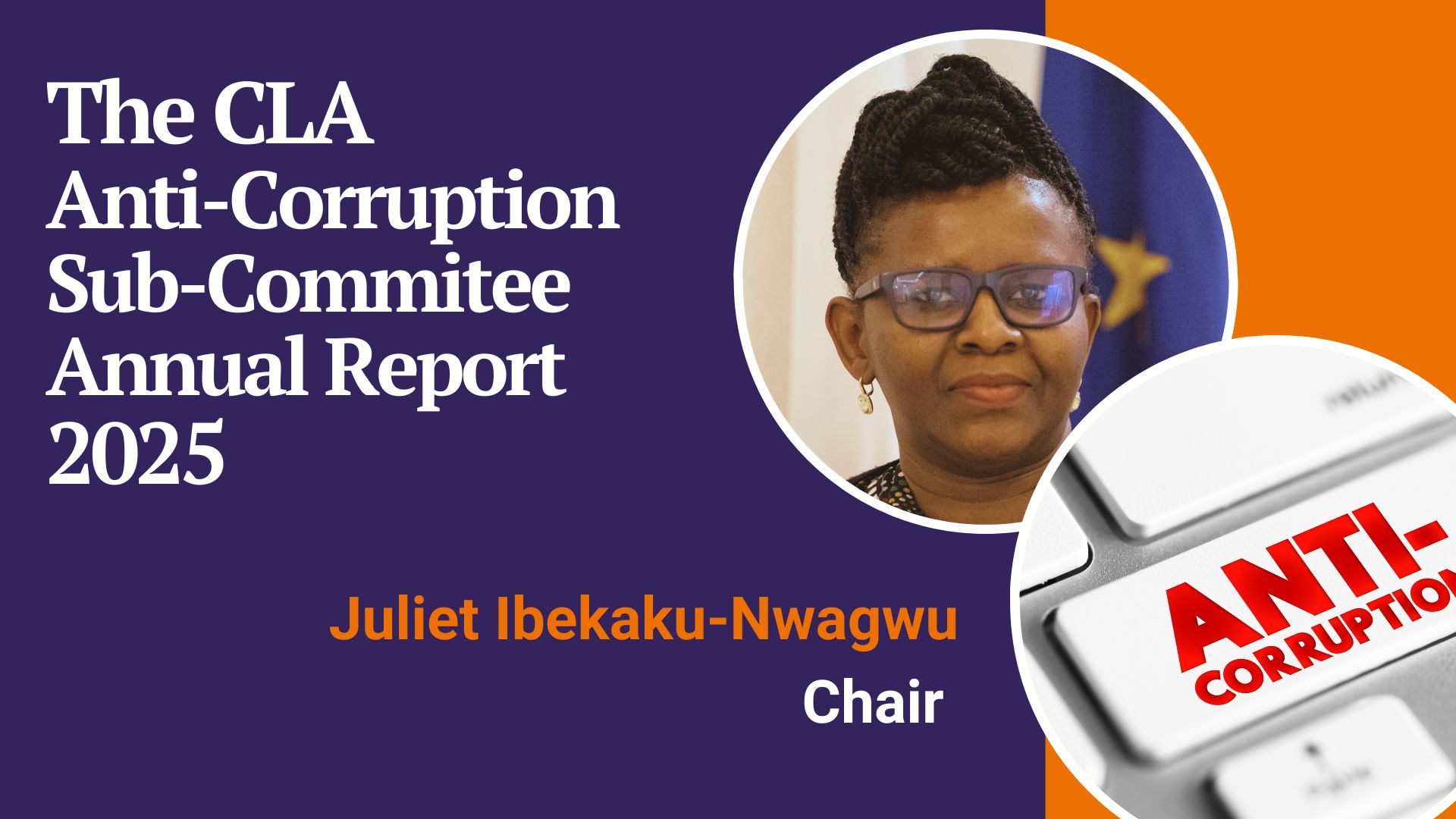
CLA News / CLA Anti-corruption Sub-committee: Chair’s 2025 Annual Report

The Commonwealth Law Association (CLA) Anti-Corruption Subcommittee plays a central role in strengthening integrity, accountability, and good governance across Commonwealth jurisdictions. As corruption grows increasingly complex, spanning borders, legal systems, and emerging technologies, our Subcommittee provides a dedicated, expert forum for lawyers, regulators, academics, and compliance professionals to collaborate on solutions.
Through regular meetings, thematic working groups, publications, trainings, and conference sessions, we advance critical conversations on asset recovery, AML/CFT compliance, bribery prevention, white-collar crime, and legal-sector vulnerabilities. We provide practical guidance to practitioners, contribute to policy dialogue, and support the development of legal frameworks that promote transparency and deter corruption.
Our work is especially significant given the global rise in sophisticated financial crimes, the threats faced by anti-corruption lawyers, and the urgent need for stronger cooperation, both within the Commonwealth and internationally. The Subcommittee’s efforts help reinforce the rule of law and safeguard public trust, demonstrating the CLA’s leadership in confronting corruption, defending democratic values, and protecting those who work on the frontline of justice.
As Chair of the CLA Anti-Corruption Subcommittee, I am pleased to provide this consolidated report of our engagements and activities from February to November 2025. The period has been productive and deeply collaborative, reflecting our shared commitment to strengthening anti-corruption frameworks across the Commonwealth.
February Meeting – 13 February 2025
At our first meeting of the year, I welcomed members and acknowledged those in attendance, as well as received apologies. We began by reviewing our thematic structure and agreed to introduce White Collar Crime as a new area of focus. This addition complemented our existing working groups on Asset Tracing and Recovery, Bribery, AML and sanctions, and Research.
To enhance member engagement and visibility, we agreed to update the Committee’s webpage and explore publishing evaluation reports. I committed to creating a Google Form to collect information about members for short-profile interviews to be featured online. Members were also encouraged to join our WhatsApp group to facilitate the sharing of updates and opportunities.
We discussed publication opportunities and encouraged contributions to the CLC25 Malta Souvenir Journal, future Commonwealth Lawyer Journals, and monthly newsletters. I also confirmed our 60-minute anti-corruption lunchtime session scheduled for 8 April at CLC25 Malta, where I would chair and speak on the legal regulatory compliance in Nigeria. Quinton Newcomb would present on United Kingdom (UK) regulatory compliance, while Steve Hill of the International Institute for Justice and the Rule of Law would speak on global engagement opportunities.
Our guest speaker, Irene Kariuki, gave an insightful overview of her article on the gambling industry compliance. Her observations on regulatory gaps, cross-border vulnerabilities, and the role of in-house counsel stimulated a productive discussion, with contributions from Hadassah and Diana. I also indicated my plan to present on Nigeria’s legal-sector risk assessment at our next meeting. Furthermore, we revisited the ongoing discussions around an International Anti-Corruption Court (IACC). I committed to exploring convening a wider meeting through my UNCAC Coalition network to deepen engagement on the issue.
Commonwealth Law Conference (CLC 25) 2025
During the Commonwealth Law Conference held in April 2025, I facilitated and served as a panelist in the following sessions:
- The Asset Recovery, Enforcement & Sanctions session, delivered during the Family Law Symposium and co-hosted by the CLA Family Law Committee, IAFL, and the FLBA, formed part of the “Show Me the Money” series on Family Law, Trusts, Recognition, and Enforcement. This pre-conference session offered a highly practical, solutions-driven discussion on the challenges of enforcing judicial orders across borders, specifically, how an order issued in State A may be executed in State B. Moderated by William Longrigg, the panel featured Zoe Saunders, Stephen Baker, Lloyd DeVincenzi and myself. We explored asset tracing methodologies, cross-border enforcement strategies, the influence of sanctions regimes, and key considerations relating to timelines, costs, and legal pitfalls that practitioners must navigate.
- Panel D1: Combatting Transnational Organised Crime in the Commonwealth – Opportunities and Challenges, held during Plenary Panel 1 (“Democrats and Despots – Does Consensus Work?”), I chaired the panel with Richard Salter KC (England & Wales), Loretta Joseph (Senior Policy Advisor and Consultant to the Commonwealth Secretariat on the Model Law for Virtual Assets), and Ola Olukoyede, Chairman of Nigeria’s Economic and Financial Crimes Commission (EFCC). The panel addressed a wide spectrum of cross-cutting issues, including lessons from the UK Modern Slavery Act, cross-border financial crime trends, regulation of cryptocurrency and virtual assets, combating terrorist financing and proliferation financing, the implications of FATF enhanced monitoring for non-compliant countries, and the vital role of legal practitioners in guiding corporate clients on their regulatory obligations.
- The CLA Anti-Corruption Subcommittee Lunch Break Review on Anti-Money Laundering (AML) Compliance in the Legal Profession focused on the central role of legal professionals in preventing money laundering and countering the financing of terrorism (AML/CFT). The session offered practical insights into emerging compliance obligations across Commonwealth jurisdictions. Panellists included Quinton Newcomb (Fieldfisher, London), Steven Hill (Executive Director, International Institute for Justice & the Rule of Law), and Lady Anande Trotman-Joseph (Chairperson, Commonwealth Association of Integrity Commissions & Anti-Corruption Bodies).
- Tackling Transnational Corruption – From Theory to Practice, Measuring Commonwealth Progress, examined the role of the private sector in corruption prevention, the importance of beneficial ownership transparency, and the implementation of the United Nations Convention against Corruption (UNCAC), particularly in relation to asset recovery and the return of proceeds of crime. Using practical case studies, panellists discussed the challenges inherent in the asset recovery process, best practices for overcoming them, and the potential for recovered assets to support sustainable development. The panel featured Stephen Baker (Managing Partner, Baker and Partners LLP), Adam Riley (3 Hare Court), and Ruggles Ferguson (Managing Partner, Ciboney Chambers).
Some pictures from the sessions can be found here.
29 May 2025 Meeting
We reviewed the Committee’s contributions to CLC25 Malta. Stephen Baker chaired a major session on tackling transnational corruption, with Adam Riley serving as a panellist. I chaired the session on combating transnational organised crime and also participated in the Family Law Symposium. Eric Theuri presented on AML regulations and legal professional privilege. During our ACSC Lunch Meeting at the conference, I again led discussions on AML compliance, joined by Quinton, Steven Hill, and Lady Anande.
The meeting ended with encouragement for the subcommittee members to actively participate in meetings and CLA activities.
The 11th Annual Commonwealth Caribbean Association of Integrity Commissions and Anti-Corruption Bodies (CCAICACB) Conference, 4th June 2026
The 11th Annual Commonwealth Caribbean Association of Integrity Commissions and Anti-Corruption Bodies (CCAICACB) Conference took place from June 2-6, 2025, in Saint Lucia. Hosted under the theme “Recommitting to Fighting Corruption Effectively and Sustainably in the Caribbean,” it convened regional anti-corruption bodies to exchange knowledge and promote best practices in integrity and anti-corruption efforts. During the conference, I presented a paper on “The Critical Role of Asset Declaration in Combating Money Laundering and Enhancing Asset Recovery Laws and Policies.” In it, I highlighted how mandatory, transparent asset declarations by public officials serve as a foundational tool for detecting illicit enrichment early, disrupting money laundering networks, and strengthening legal frameworks for asset recovery worldwide. The engagement opened avenues for cross-regional collaboration within the Commonwealth. The presentation can be found here
Meeting with the International Anti-Corruption Court Team – 13 June 2025
We convened a special session to engage with representatives advancing the establishment of the International Anti-Corruption Court. This provided a valuable platform for examining the Court’s potential role and relevance to Commonwealth jurisdictions. It also allowed for meaningful discussion on how the IACC could strengthen global accountability mechanisms.
11 September 2025 Meeting
This meeting brought together a wide group of colleagues. We were joined by our guest speakers, Francisca Pretorius and Neill Stansbury, who presented on the Commonwealth Anti-Corruption Benchmarks. Francisca outlined the principles, structure, and collaborative development process, while Neill presented the 25 auditable benchmarks and underscored the need for strong training programmes, secure whistleblower systems, and coordinated public-sector oversight mechanisms.
Francisca also shared experiences from the implementation pilot in Trinidad and Tobago, and Neill directed members to GIACC’s free multilingual anti-corruption training modules.
During updates from members:
- I briefed the Committee on my participation in the August 2025 Nigerian Bar Association Conference, where I represented the CLA President and spoke on the theme of “Dirty Money.”
- Tyra provided updates on the establishment of an anti-corruption unit in Guyana.
- Hadassah informed us of YCLA’s preparations for a 2026 virtual conference, and their interest in collaborating with our subcommittee on compliance and regulatory themes.
We confirmed our webinar for 13 November on the arguments for and against the IACC, and I proposed that the Committee publish a Statement in recognition of International Anti-Corruption Day in December. Members were invited to contribute to this draft.
We also discussed upcoming international events, including the Conference of State Parties to the UN Convention Against Corruption in Doha (December 2025), the CLA Rwanda Conference in 2026, and CLC27 in Darwin in May 2027.
Members were once again encouraged to submit articles for publication in CLA platforms. Our meeting closed with a solemn tribute to the late South African anti-corruption lawyer Bouwer van Niekerk, whose murder underscored the risks faced by practitioners combating corruption globally.
Virtual Launch Coalition for the International Anti-Corruption Court (IACC)-18th November 2025
As part of our ongoing commitment to global anti-corruption advocacy, the Subcommittee also participated in the virtual launch of the Coalition for the International Anti-Corruption Court (IACC). During this session, we were introduced to the convening organisations, Integrity Initiatives International (III), III Europe with its regional focus, and Good Governance Africa, which collectively staff and coordinate the IACC project. The launch provided a comprehensive briefing on the progress of global advocacy efforts, including updates on the drafting process for the IACC treaty. We were also introduced to the emerging structure of the Coalition and the various avenues through which partners, including our Subcommittee, can contribute meaningfully to the campaign. In addition, the organisers unveiled a developing communications toolkit designed to empower partners to advance public engagement and advocate for the IACC across national, regional, and international platforms. Our participation reaffirmed the Subcommittee’s commitment to supporting multilateral efforts that strengthen accountability and combat grand corruption.
Meeting-19th November 2025.
Krish Govender provided a detailed overview of South Africa’s current anti-corruption landscape. He highlighted the country’s dual-investigatory approach, involving both a judicial commission and a parliamentary committee conducting parallel inquiries into high-level corruption. Krish underscored the constructive roles of the public and media in driving accountability, noting that these efforts have already resulted in the suspension of senior officials. Given the value of this insight, I encouraged Krish to consider preparing a newsletter article to help disseminate these developments more widely within the Commonwealth legal community.
Hadassah Igoche briefed the committee on the Nigerian Bar Association’s ongoing work to strengthen lawyers’ compliance with AML regulations. She described the nationwide workshops currently taking place, which aim to enhance awareness among legal practitioners of their obligations under AML rules. Although she observed varying levels of understanding across jurisdictions, she reported that the initiative has been positively received and is already contributing to improved compliance practices.
I also drew members’ attention to the forthcoming 11th United Nations Conference of State Parties in Doha, where I will be chairing panels on victims of corruption and highlighting the establishment of a database for UNCAC members.
We then considered our recent webinar on the arguments for and against the International Anti-Corruption Court, held on 13 November in partnership with Integrity Initiatives International. I thanked Diana Constantinide for her excellent role as moderator. Members were reminded that the session is now available for replay on YouTube and Spotify.
Under publications, I proposed that the committee increase its visibility by contributing articles and thought leadership pieces to CLA newsletters and making a collective contribution for International Anti-Corruption Day on 9 December. Members were also encouraged to submit content to the Commonwealth Lawyer Journal ahead of the 1 February 2026 deadline, as well as to the monthly CLA newsletters.
We reviewed several upcoming events of strategic importance.Clare provided an update on the forthcoming Kigali Legal Forum, a two-day conference organised in collaboration with the Rwanda Bar and the IAFL, with a date of 29th-30th October 2026. The subcommittee was invited to suggest session themes and express interest in speaking. Quinton Newcomb suggested exploring alignment opportunities with a cricketing charity, Cricket Builds Hope, which may host a tournament around the same period.
Turning to the Young Commonwealth Lawyers Conference, scheduled for March 2026, Hadassah emphasised the need for a session focused on compliance issues affecting young lawyers. Quinton offered to support this by providing expertise in anti-bribery and corruption compliance. Both agreed to coordinate offline. We noted that CLC27 in Darwin is confirmed for 9–13 May 2027, with the Papers Committee meeting later this month. Clare will update us on potential speaking opportunities, and expressions of interest are welcome.
The committee then discussed the theme for International Anti-Corruption Day 2025: “Uniting Youth Against Corruption: Shaping Tomorrow’s Integrity.” Quinton proposed establishing a Q&A-based discussion group for young lawyers to explore their perceptions of corruption and its real-world impacts. I welcomed this initiative and recommended that Quinton convene and chair a sub-panel to lead conversations with young adults. Hadassah confirmed that the Young Commonwealth Lawyers Committee would be keen to collaborate.
I reiterated my enthusiasm for contributions to newsletters and the development of a strong joint statement or article in commemoration of International Anti-Corruption Day.
- Committee Co-convenors meeting- 16th December, 2025
The recent CLA Committee Co‑convenors meeting focused on strengthening our committee activities, member engagement, and future initiatives. . Steven Thiru underscored the importance of showcasing the committee’s work as a marketing tool to attract new members and raise its profile.
Steven and Brigid stressed the need to clarify leadership roles within the Committee to ensure effective functioning and succession planning. They identified difficulties in engaging members and generating project ideas, and recommended inviting guest speakers to stimulate participation. Maria Mbeneka suggested transitioning from webinars to podcasts to sustain interest and also proposed partnering with jurisdictional members for future events. Overall, the discussion highlighted the need for innovative strategies to strengthen member involvement and leadership development.
David Greene reported that the Freedom of Expression webinar had been highly successful, drawing 3,400 registrants, and outlined plans for a follow‑up webinar on the death penalty in collaboration with the Death Penalty Project. He emphasised the centrality of the rule of law and considered hosting a separate webinar devoted to this theme. Hasan Irfan Khan confirmed he would represent the CLA in Tokyo and expressed interest in CLA participation in the Mexico City conference. David further underlined the value of working with organisations such as the IBA to increase visibility and support human rights initiatives.
Mark Woods updated the meeting on several committee projects, including the Family Law Committee’s examination of mediation practices and the Papers Committee’s preparations for the forthcoming Darwin programme. He proposed establishing a centralised directory to publicise webinars and conferences, thereby improving their visibility and accessibility for legal professionals. The group recognised the benefits of co-batching webinars and engaging law associations to secure international speakers. Brigid emphasised the importance of building partnerships and undertaking research to deepen committee engagement.
Conclusion
In closing, I am encouraged by the commitment, expertise, and energy demonstrated by all members of the Anti-Corruption Subcommittee. Our discussions continue to reflect the growing complexity of anti-corruption work across Commonwealth jurisdictions, as well as the critical role our committee plays in shaping thought leadership, strengthening professional standards, and supporting collaborative reform efforts.
I remain grateful for the dedication and active participation of each member, and I look forward to building on this momentum as we prepare our strategy and projects for 2026. Together, we will continue to champion integrity, elevate professional standards, and support meaningful governance reforms across the Commonwealth
Juliet Ibekaku-Nwagwu
Chair