


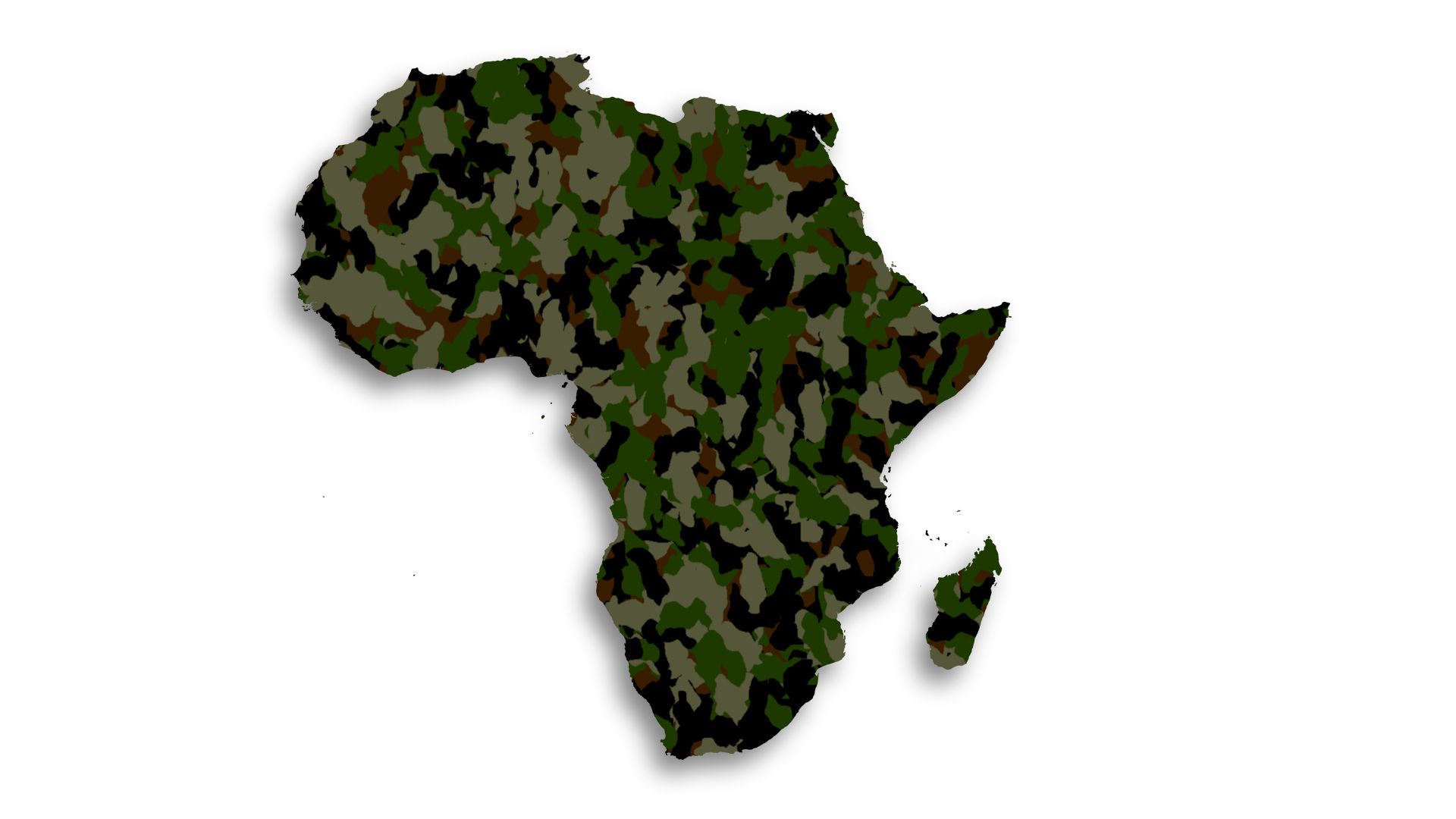
CLA News / Trump’s threats of military intervention in Nigeria: An exposure of fragilities in African regional integration? by Fauziya Tijjani

Introduction
Africa’s Agenda 2063 faces significant challenges that threaten its success. Unless decisive and strategic actions are taken now, it’s at risk of falling short of its transformative goals.
In late October 2025, President Trump fierily accused the Nigerian government of failing to protect Christians from what he terms “existential threats” by Islamist groups.[2] This subsequently escalated into a direct order for the Pentagon to plan a military action.[3] President Trump described it as a humanitarian imperative and threatened intervention through “guns-a-blazing”, which, as the Washington Post had reported, shook key players, aides and even those who were pushing it.[4] This also sent back flashbacks to what happened in countries such as Libya, Vietnam, and Iraq, to mention but a few. Nigeria, Africa’s most populous nation, ECOWAS’s economic powerhouse and, by necessary implication, the AU, swiftly rejected the claims, but the damage is done because it has sent whispers of impending destabilisation. This is no isolated barb; it’s a stark reminder of Africa’s vulnerability.
Without continental military unity, external powers can exploit fissures, unravelling the African Union (AU), the Economic Community of West African States (ECOWAS), and the African Continental Free Trade Area (AfCFTA)—the very pillars of African progress, integration and unity.
The nuance in the storm: Some deeper arguments
Some may argue that Trump’s statements are just political theatrics to win favour of certain American groups, especially Christian voters, because the US is heading towards the 2026 midterm elections.[5] Also, this rhetoric of his just mirrors a 2025 U.S. Commission on International Religious Freedom (USCIRF) report that labelled Nigeria a “Country of Particular Concern”.[6] Further, another argument is that his statement cannot hold firm because the US military is already stretched because of conflicts in Ukraine and Taiwan and so is unlikely to open a new major conflict in West Africa.[7] Lastly, other major players such as China and Russia have major interests in Nigeria, such as over USD 60 billion in infrastructure invested by China through the Belt and Road Initiative and Russia having growing influence in the Sahel region through Wagner mercenary proxies.[8] So even if his comments may be merely political, they touch on sensitive areas in African geopolitics – the fissures of different interests in the region. Thus, notwithstanding that, it still has the potential to scare investors, destabilise markets, thwart the efforts being made in African regional integration, embolden insurgent groups in Africa and damage Nigeria and the region’s image globally.
The indispensable role of Nigeria
The importance of Nigeria in the AU, AfCFTA and ECOWAS cannot be overstated. Nigeria is deemed one of the third largest economies in Africa, with a nominal GDP of USD 586 billion as of 2025 out of the continent’s 54 countries.[9] It is ECOWAS’s de facto leader, as it hosts 70% of the bloc’s peacekeeping forces, hosts its secretariat and anchors trade routes vital to AfCFTA’s $3.4 trillion market.[10]
The AU and Africa cannot afford a destabilised Nigeria. The Sahel juntas (Mali, Niger, and Burkina Faso) already exited ECOWAS in 2024, forming the Alliance of Sahel States and fracturing regional security, but we cannot afford a foreign intervention in Nigeria with all the precedents that have been set in other countries. This echoes the AU’s broader plight, with eight coups since 2020 without any success in pushing back to democratic rule because of a weak, fragmented and siloed military. As V. Ntwali argues, national security failures “transpose to the regional level”, eroding institutional autonomy and stalling economic integration: why would someone invest in AfCFTA corridors when the borders are bleeding instability?[11]
Evidence from the Frontlines: Security as Economic Lifeline
Peer-reviewed evidence underscores the linkage. Military disunity isn’t just a security gap. It sabotages economic progress.[12] MG Gnidehou and CY Faton, in their article ‘Military expenditure and economic growth in African countries: the role of institutional quality’, have evinced the positive relation between military stability and unity and economic growth. In their article titled “Military expenditure and economic growth in African countries: the role of institutional quality”, they used data from the World Bank (WDI) over the period 2002–2021 to show that military spending has a positive and significant influence on economic growth in Africa.[13] Even currently, porous frontiers in Nigeria, like its northern flanks, have been seriously disrupting the facilitation of trade, thus demanding cross-border coordination through AU-led forces.[14] We cannot afford more destabilisation and porousness.
From OAU Indifference to APSA Promise
The African Union’s (AU) evolution from the Organisation of African Unity (OAU) demonstrates the promise of unity and the cognisance of the threat of it thereof.[15] The 2002 Constitutive Act marked a shift from indifference, leading to the establishment of the African Peace and Security Architecture (APSA) for collective defence.[16] Its interventions in Burundi and Sudan fostered stability and demonstrated unity, paving the way for economic pacts.[17] However, as IEW Chirisa & others point out, without the amalgamation of efforts, disparities would continue to persist.[18] Political instability and economic disparities hinder goals such as intra-African trade, which is now the core of the African Continental Free Trade Area (AfCFTA).[19]
The Urgency
Trump’s threat further brings to light the urgency of the situation. If Nigeria is to falter, ECOWAS crumbles, the AU loses credibility, and the AfCFTA, already struggling with insecurity, will fade.
The Path Forward
The solution lies in a unified African Standby Force under APSA. This unified force would be able to pool resources for rapid response and border patrols to help safeguard Africa’s regional integration. As V. Ntwali concludes, African states must prioritise norms over sovereignty to reclaim their legitimacy on the global platform.[20]
Conclusion
In conclusion, Africa’s progress demands military unity to safeguard against internal and external threats to its integration, or it risks perpetual destabilisation by such threats.
Author: Fauziya Tijjani [1]
[1] Fauziya is lawyer from Ghana and holds the following qualification: LLB, BL (Ghana), LLM (University of Pretoria)
[2] https://www.theguardian.com/us-news/2025/nov/01/trump-nigeria-christian-persecution (accessed 10 November 2025)
[3] https://www.theguardian.com/us-news/2025/nov/01/trump-nigeria-christian-persecution (accessed 10 November 2025)
[4] The Whashington post https://www.washingtonpost.com/politics/2025/11/09/nigeria-trump-christians-military-action/ (accessed 10 November 2025)
[5] Trump moves to use the levers of presidential power to help his party in the 2026 midterms https://apnews.com/article/trump-midterms-election-2026-voting-redistricting-e0e8f3214dcc9c7d614130e2857964bf (accessed 10 November 2025)
[6] US International Religious Freedom 2025 A N N U A L R E P O R T https://www.uscirf.gov/sites/default/files/2025-03/2025%20USCIRF%20Annual%20Report.pdf (accessed 10 November 2025) 3
[7] Deterring Russia: U.S. Military Posture in Europe https://www.csis.org/analysis/deterring-russia-us-military-posture-europe (accessed 10 November 2024)
[8] AA Chinonso & OI Jonah ‘China’s Belt and Road Initiative and Infrastructure Development in Nigeria: A Paradigm Shift or Failed Ventures Repackaged?’ (2023) 9 China Quarterly of International Strategic Studies 195-225 and Russia Deepens Ties with Sahel Countries in Military Talks https://politicstoday.org/russia-deepens-ties-with-sahel-countries-in-military-talks/#:~:text=Russia’s%20military%20footprint%20in%20Africa,in%20the%20Sahel%20with%20ECOWAS? (accessed 10 November 2015)
[9] World Economics https://www.worldeconomics.com/GDP/Nigeria.aspx (accessed 10 November 2025)
[10] JB Sunday ‘A Critical Analysis of Nigeria’s Relationship With ECOWAS’ LLM thesis, Final International University (2023)
[11] VI Ntwali ‘The African Union and its regional economic communities confronted with coups d’état: Between condemning and condoning.’ (2025) 7 Frontiers in Political Science.
[12] MG Gnidehou & CY Faton ‘Military expenditure and economic growth in African countries: the role of institutional quality.’ (2025) 6 Discov Sustain 343
[13] MG Gnidehou & CY Faton (n 8) 343
[14] Trade Disruption to persist in Northern Nigeria https://frontierview.com/insights/trade-disruption-to-persist-in-northern-nigeria/ (accessed 10 November 2025)
[15] A Bujra ‘Africa: From the OAU to the African Union’ Cooperation South
[16] African Peace and Security Architecture https://www.peaceau.org/uploads/african-peace-and-security-architecture-apsa-final.pdf
[17] A Jeng ‘The African Union peacebuilding travails in Burundi’ In: Peacebuilding in the African Union: Law, Philosophy and Practice (2012) Cambridge University Press, 202-233.
[18] IE Chirisa, A Mumba & SO Dirwai ‘A review of the evolution and trajectory of the African union as an instrument of regional integration’ (2014) 3 SpringerPlus 101
[19] U Lutalo ‘Political Instability: A Barrier to Regional Economic Integration in Africa’ (2024)
[20] VI Ntwali (n 7).