

CLA News / Jaipur Conference Reflection Piece – From Conflicts to Dialogue: Mediation as a Pathway to Global Peace

Modern history has long attempted to enshrine “peace” as a foundational global concept. Towards the end of the Napoleonic Wars, the world was gifted Leo Tolstoy’s literary masterpiece, War and Peace. Yet, despite these early conceptual introductions to harmony, humanity still descended into the First World War, where colonial powers clashed on a global scale. In the aftermath of that conflict, global leaders sought unconventional ways to prevent future wars. In 1930, Uruguay stepped forward to host the inaugural FIFA World Cup, driven by a profound underlying purpose: to replace the Gun with the Ball and foster peace through international sporting camaraderie. Unfortunately, this attempt to give sport a peacekeeping mandate did not yield lasting results, and the world soon witnessed the devastation of the Second World War.
In the aftermath, leaders recognised that peace required more than a gesture; it required formal, structural frameworks. The dialogues and deliberations among these leaders paved the way for Bretton Woods institutions and the birth of the United Nations, with the core mandate of institutionalising peace and resolving conflicts exclusively through dialogue. Shortly thereafter, the world experienced a wave of decolonisation. Subsequent decades brought the rise of democratic societies & institutions, parliamentary governance, adult franchise, and the rule of law. The democratic premise rested on a simple faith: that societal conflict could be resolved peacefully through debate and dialogue.
Yet, more than five to seven decades after the emergence of many post-colonial democracies, visible cracks began to appear in the institutional edifice created after the Second World War. Conflicts persisted, polarisation deepened, and faith in dialogue diminished.
During the interregnum, Mediation emerged as a vital method for dispute resolution at various levels. The West embraced it as a structured, scientific alternative to litigation, and it has since taken full flight there. In the East, Mediation is still taxiing on the runway, though it is beginning to lift off, with pioneering jurisdictions like Singapore, etc, leading the way.
Concurrently, the United Nations adopted its Sustainable Development Goals for 2030, and the Commonwealth Charter came into being, both heavily underscoring peace as an underlying objective. We also witnessed a landmark step towards institutionalising mediation with the unanimous adoption by the United Nations General Assembly, in December 2018, of the United Nations Convention on International Settlement Agreements Resulting from Mediation, which took shape in the form of the Singapore Convention in August 2019.
Within the Commonwealth legal fraternity, outreach initiatives such as Mission Commonwealth Connect gained significant momentum. Reaching out to every corner, the Commonwealth Lawyers Association (CLA) strengthened its institutional reach by ensuring representation from every member country on its Council; further, by establishing several committees, it broadened participation across the legal fraternity. All in furtherance of upholding the rule of law.
We even saw sports diplomacy emerge among legal professionals through initiatives like the Lawyers Cricket World Cup with the motto “Cricket for Friendship” and, notwithstanding this, the Commonwealth Secretariat’s initiative of “Peace at the Crease” gave further impetus. At a larger level, the Commonwealth Games and the Olympic movement continued to underscore sport’s role as a medium for peace across societies worldwide.
More than a decade ago, the concept of “peace jurisprudence” began to take root in the Caribbean region. At a conference hosted for the legal fraternity by the Trinidad and Tobago Mediation Board, school children were invited to discuss the types of disputes trending among their peers. When their Prime Minister formally opened the conference that afternoon, he was informed of a striking observation made by the children: peace must first be seen in parliamentary proceedings. Moved by this, the Prime Minister remarked that had mediation been firmly established a century ago, perhaps the universe could have been spared the devastation of the two World Wars, adding that the Caribbean region could play a stellar role in securing future global peace.
Drawing on these historical and contemporary developments, NIVAARAN, a collective of mediators based at the Supreme Court of India, launched a series of online guest lectures, webinars, and in-person meetings, with its flagship event being the International Summer School on Mediation for building awareness across the Commonwealth. Simultaneously, the CLA’s ADR Committee took shape to champion mediation, working closely with the Singapore International Mediation Centre (SIMC) to support and expand the Summer School model across the Commonwealth. The Committee also organises guest lectures, conferences, and other initiatives to promote greater awareness and adoption of mediation as an effective means of dispute resolution.
The Caribbean legal fraternity sought to replicate this model, leading to the creation of “The Caribbean Waves Mediation Series.” The aspiration is for these mediation waves to eventually touch the shores of Africa through an anticipated “African Safari Mediation Series”, and, in time, to reach across the Commonwealth.
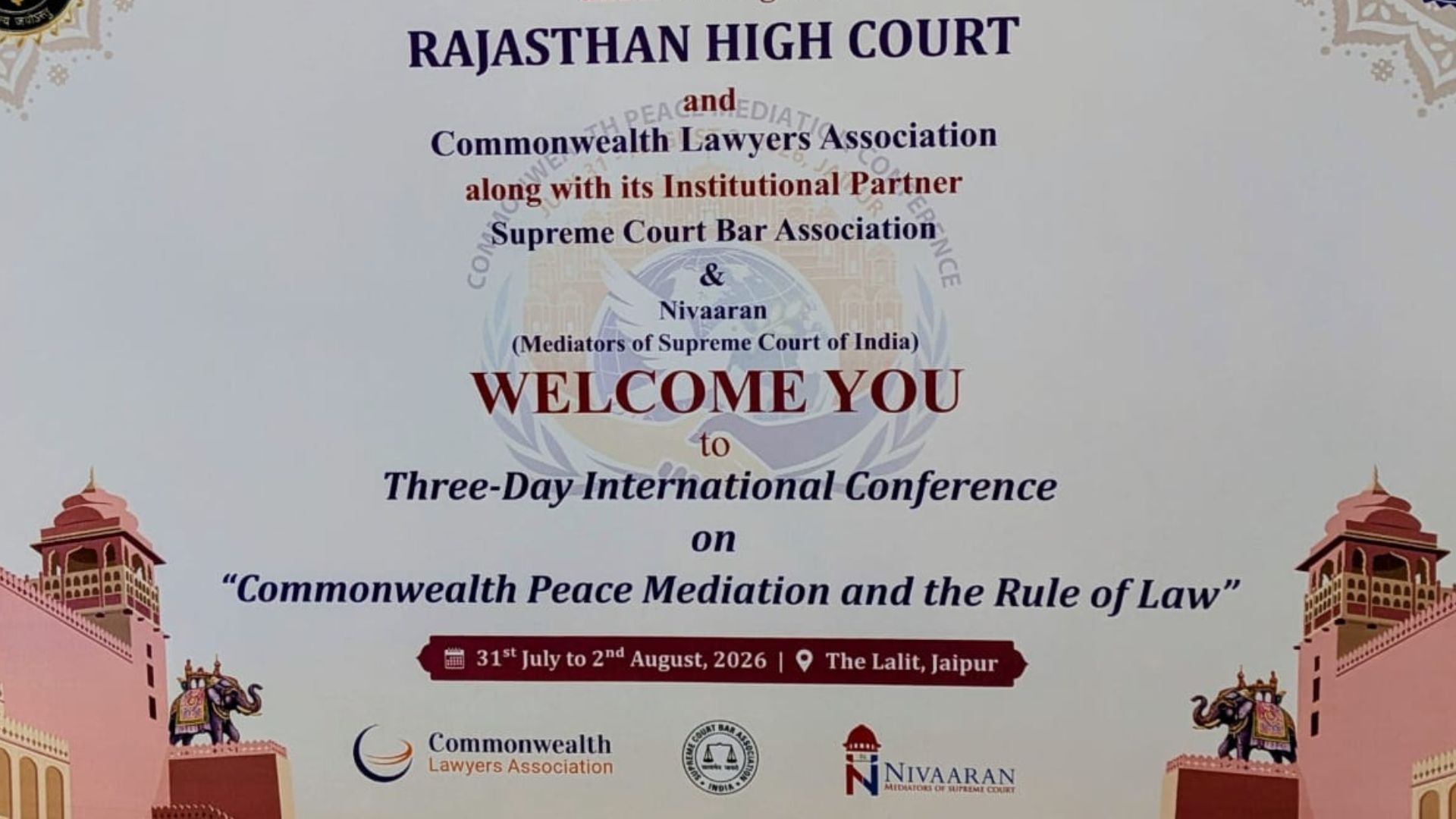
The seeds for a unified global initiative for Peace Mediation were planted last year in Kandy, Sri Lanka, during the course of attending a conference. We shared the vision of hosting a conference on the theme of “Peace mediation and the Rule of law” with the Chief Justice of India and subsequently with his next-in-command. To bring this vision to life, we travelled to Jaipur to meet the Acting Chief Justice of Rajasthan, who immediately embraced the idea and, through the Rajasthan State Legal Services Authority, graciously took on the responsibility of hosting the conference. Concurrently, we also took on board the Commonwealth Lawyers Association and the Supreme Court Bar Association of India. Thanks to the extraordinary dedication of judicial officers across the state, the Commonwealth Peace Mediation Conference (CPMC26) was successfully executed from 31st July to 2nd August 2026.
Alongside the conference, drawing upon historical perspectives and the current global climate, the JAIPUR DECLARATION was drafted collectively, drawing on expertise from across the Commonwealth. It was formally adopted, bearing the first signature of the Chief Justice of India, Justice Surya Kant, and a formal concluding signature of Justice Vikram Nath, Judge of the Supreme Court of India. The Declaration was further strengthened by the signatures of distinguished Commonwealth jurists and representatives: Justice Abha Patel of the Supreme Court of Zambia; Justice Vasheist Kokaram of the Court of Appeal of The Bahamas; Justice A.H.M.D. Nawaz of the Supreme Court of Sri Lanka; and Mrs. Vimbai Nyemba, Permanent Secretary, Ministry of Justice, Legal and Parliamentary Affairs of Zimbabwe, together with delegates from across the Commonwealth, including representatives of LexisNexis, united by a shared commitment to advancing the cause of peace.
The Declaration now stands as a vital aspirational document, one that we hope the Commonwealth Lawyers Association and its sister organisations will adopt, as well as the Commonwealth Heads of Government Meeting (CHOGM) in Antigua this November. Hopefully, it will be formally embraced, carrying a unified message of peace across the Commonwealth and beyond.
In his opening address, the Chief Justice of India observed that Jaipur was built on principles of harmony and proportion, so that no part of the city overwhelms another, making it a fitting venue for a mediation conference. Coupled with the deliberations in the conference, Justice Kokaram, Judge of the Appeal Court of the Bahamas, in his closing address, declared Jaipur not only the Pink City, but also the Peace City: a symbol of what the Commonwealth aspires to be. In that spirit, we closed the conference with a call to carry the Pink and Peace torch from Jaipur to the Bahamas.
Authors: Santhaan Krishnan, Arun & Nandini