

CLA News / Steven Thiru, President of the Commonwealth Lawyers Association: “We Are Witnessing a Decline in Judicial Independence” By Le Défi Quotidien

Published: 25 June 2026 at 3:00 p.m.
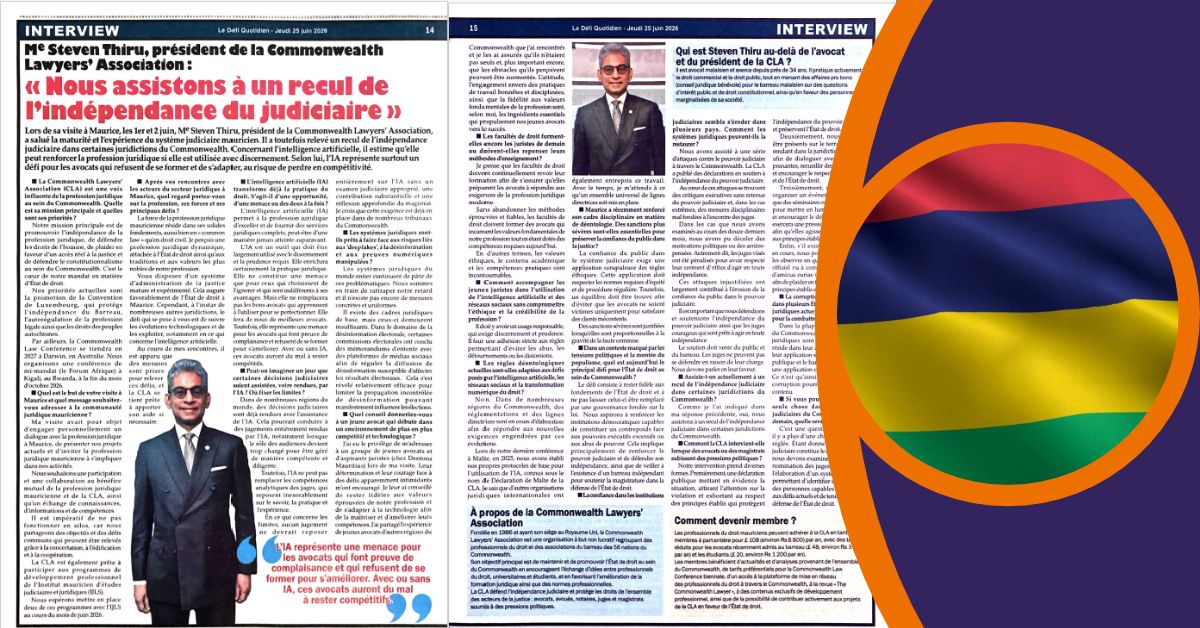
The original article was published in French by Le Défi Quotidien, a French-language daily newspaper in Mauritius, accessible here. The English version below is an unofficial translation prepared for the CLA website; it was not provided or published by Le Défi Quotidien.
During his visit to Mauritius on 1–2 June, Steven Thiru, President of the Commonwealth Lawyers Association (‘CLA’), praised the maturity and experience of the Mauritian judicial system. However, he noted a decline in judicial independence in certain Commonwealth jurisdictions. On artificial intelligence (‘AI’), he believes it can strengthen the legal profession if used wisely. In his view, AI primarily represents a challenge to lawyers who refuse to learn and adapt, thereby risking their competitiveness.
1) The Commonwealth Lawyers Association (‘CLA’) is an influential voice for the legal profession within the Commonwealth. What is its main mission, and what are its priorities?
Our principal mission is to promote the independence of the legal profession, protect human rights, advocate for meaningful access to justice, and uphold constitutionalism throughout the Commonwealth. This is the heart of our rule of law mandate.
Our current priorities are promoting the Luxembourg Convention, which safeguards the independence of the Bar; the self-regulation of the legal profession; and the rights of Indigenous peoples.
In addition, the Commonwealth Law Conference will be held in Darwin, Australia, in 2027. We will also be hosting our mid-term conference — the Africa Forum — in Kigali, Rwanda, at the end of October 2026.
2) What was the purpose of your visit to Mauritius, and what message would you like to convey to the Mauritian legal community?
My visit was intended to personally engage in a dialogue with the legal profession in Mauritius, present our current initiatives, and invite the Mauritian legal profession to become involved in the CLA’s work.
We seek participation and collaboration that will mutually benefit the Mauritian legal profession and the CLA, as well as an exchange of knowledge, information, and expertise.
It is imperative that we do not operate in silos, as we share common objectives and challenges that can best be addressed through consultation, capacity-building, and cooperation.
The CLA is also ready to participate in the professional development programmes of the Mauritius Institute for Judicial and Legal Studies (‘IJLS’).
We hope to implement two such programmes with the IJLS in June 2026.
3) Following your meetings with members of the legal sector in Mauritius, how do you view the profession, its strengths, and its principal challenges?
The strength of the Mauritian legal profession lies in its solid foundations in both common law and civil law. I see a dynamic profession committed to the rule of law and to the noblest traditions and values of our profession.
You have a mature and experienced system of administration of justice. This bodes well for the rule of law in Mauritius. However, as in many other jurisdictions, the challenge you face is keeping pace with technological developments and making effective use of them — particularly in relation to AI.
During my meetings, it became clear that measures are already being taken to address these challenges, and the CLA stands ready to provide assistance whenever needed.
4) AI is already transforming legal practice. Is it an opportunity, a threat, or both?
AI enables the legal profession to excel and deliver comprehensive legal services, perhaps in ways never previously achieved.
AI is a tool that should be widely used, with the necessary discernment and prudence. It will certainly enrich legal practice. It poses a threat only to those who choose to ignore it and are indifferent to its benefits. But AI will not replace good lawyers who learn to use it to become better at what they do. It will make us better lawyers. However, it represents a threat to lawyers who are complacent and refuse to develop their skills to improve. With or without AI, such lawyers will find it difficult to remain competitive.
5) Could we one day see judicial decisions assisted — or even made — by AI? Where should the limits be drawn?
In many parts of the world, judicial decisions are already being made with the assistance of AI. This could lead to judgements being generated entirely by AI, particularly where court caseloads become too heavy to be managed competently and diligently.
However, AI cannot replace judges’ analytical skills, which are ultimately grounded in knowledge, practice, and experience.
As for the limits, no judgement should rely entirely on AI without proper judicial scrutiny, substantial input, and careful deliberation by the judge. I believe this requirement is already in place in many Commonwealth courts.
6) Are legal systems prepared to address the risks posed by ‘deepfakes’, disinformation, and manipulated digital evidence?
Legal systems around the world continue to grapple with these issues. We are still playing catch-up, and there are not yet any concrete and uniform measures in place.
Basic legal frameworks exist, but they remain insufficient. In the area of electoral disinformation, some electoral commissions have entered into memoranda of understanding with social media platforms to regulate the dissemination of disinformation that could affect election results. These measures have proven relatively effective in limiting the uncontrolled spread of disinformation that could clearly influence elections.
7) What advice would you give to a young lawyer starting out in an increasingly competitive and technological environment?
I had the privilege of speaking to a group of young lawyers and aspiring legal professionals at Dentons Mauritius during my visit. Their determination and courage in the face of seemingly daunting challenges were encouraging.
I advised them to remain true to the enduring values of our profession and to adapt to technology so that they can master it and enhance their skills.
I shared with them the experiences of young lawyers from other parts of the Commonwealth whom I have met, and assured them that they were not alone and, more importantly, that the obstacles they perceive can be overcome. Attitude, a commitment to honest and disciplined working practices, and adherence to the core values of the profession are, in my view, the essential ingredients that will propel our young lawyers towards success.
8) Are law schools still preparing tomorrow’s lawyers effectively, or do they need to rethink their teaching methods?
I believe law schools must continually review their curricula to ensure they are preparing lawyers for the realities of modern legal practice.
Without abandoning proven and reliable methods, law schools must train lawyers who embody the profession’s fundamental values while possessing the skills required today.
In other words, ethical values, academic content, and practical skills are all indispensable.
9) How can young legal professionals be supported in using AI and social media without compromising the ethics and credibility of the profession?
There must be responsible use, requiring sound judgement and caution. Strict compliance with rules is essential to prevent abuse, misuse, or distortion.
10) Are current professional ethics rules adequate to address the challenges posed by AI, social media, and the digital transformation of law?
No. Across many Commonwealth jurisdictions, new regulations and guidelines are currently being developed to meet the emerging challenges arising from these developments.
At our conference in Malta in 2025, we adopted our own basic protocols for the use of AI, known as the CLA Malta Declaration. I know that other international law organisations are undertaking similar work. Over time, I expect a universal set of guidelines to be established.
11) Mauritius has recently strengthened its disciplinary framework concerning professional ethics. Are tougher sanctions necessary to maintain public confidence in the justice system?
Public confidence in the judicial system requires the scrupulous enforcement of ethical rules. That enforcement must also meet the required standards of fairness and due process. However, a balance must be struck so that lawyers are not unfairly victimised merely to satisfy disgruntled clients.
Severe sanctions are justified when they are proportionate to the seriousness of the misconduct.
12) In a climate marked by political tensions and the rise of populism, what is the main challenge for the rule of law in the Commonwealth today?
The challenge is to remain faithful to the foundations of the rule of law, and not allow it to be replaced by rule by law. We aspire to strengthen democratic institutions capable of acting as a counterbalance to excessive executive powers or abuses of power. This primarily involves strengthening the judiciary and defending its independence, and ensuring the existence of an independent bar to support the judiciary in upholding the rule of law.
13) Public confidence in judicial institutions appears to be declining in several countries. How can legal systems restore that confidence?
We have witnessed a series of attacks on the judiciary throughout the Commonwealth. The CLA has issued statements supporting judicial independence.
At the heart of these attacks are unrestrained criticisms of the judiciary by the executive and, in extreme cases, ill-founded disciplinary measures against judges.
In the cases we have examined over the past twelve months, we have been able to detect political motivations or ulterior motives. In other words, the judges in question have been penalised for upholding their oath of office to act independently.
These unjustified attacks have contributed significantly to the erosion of public confidence in the judiciary.
It is important that we defend and support judicial independence, as well as the courageous judges who are prepared to act independently.
Support must come from both the public and the bar. Judges cannot defend themselves because of the office they hold. We must speak up in their defence.
14) Are we currently witnessing a decline in judicial independence in some Commonwealth jurisdictions?
As I indicated in my earlier response, yes, we are witnessing a decline in judicial independence in certain Commonwealth jurisdictions.
15) How does the CLA respond when lawyers or judges face political pressure?
Our response takes various forms.
First, we may issue a public statement highlighting the situation, drawing attention to the violation, and calling for respect for the established principles that protect judicial independence and uphold the rule of law.
Second, we may be present on the ground by visiting the jurisdiction concerned to engage with stakeholders, gather information, and encourage respect for principles and the rule of law.
Third, we may organise a public event, such as seminars or webinars, to highlight the issue and encourage public discussion, thereby exerting pressure on the authorities to act in accordance with established principles and the rule of law.
Finally, if legal proceedings are underway, we may seek to attend them as an official observer or appear as amicus curiae (‘friend of the court’) to advocate for adherence to established principles and the rule of law.
16) Corruption remains a challenge in many states. Are current legal mechanisms sufficient to combat it effectively?
In most Commonwealth jurisdictions, the legal mechanisms are sufficient. The challenge lies in their enforcement — or in their selective enforcement. Public pressure and the bar must demand effective and fair enforcement. Only in this way can the scourge of corruption be eradicated or contained.
17) If you could change just one thing in the judicial systems of the Commonwealth starting tomorrow, what would it be?
That is a difficult question, because there is more than one thing that needs to be addressed. Given that the judiciary constitutes the last line of defence, we must examine the system for appointing judges and work towards developing a uniform system for identifying and appointing individuals capable of meeting today’s challenges and standing firm in defending the rule of law.
Who is Steven Thiru, beyond being a lawyer and President of the CLA?
He is a Malaysian lawyer who has been in practice for nearly 34 years.
He actively practises commercial and public law, while also undertaking pro bono work (providing free legal advice) for the Malaysian Bar on matters of public interest and constitutional law, as well as representing marginalised members of society.
About the Commonwealth Lawyers Association
Founded in 1986 and headquartered in the United Kingdom, the Commonwealth Lawyers Association is a non-profit organisation bringing together legal professionals and bar associations from the Commonwealth’s 56 member nations.
Its primary objective is to maintain and promote the rule of law across the Commonwealth by encouraging the exchange of ideas among legal professionals, academics, and students, and by advocating for improvements in legal education and professional standards.
The CLA defends judicial independence and protects the rights of all those involved in the administration of justice — barristers, solicitors, notaries, judges, and magistrates who are subjected to political pressure.
How to Become a Member
Mauritian legal professionals may join the CLA as full members for £108 (approximately MUR 6,800) per year. Reduced rates are available for newly admitted lawyers (£48, approximately MUR 3,000 per year) and students (£20, approximately MUR 1,200 per year).
Members receive news and analysis from across the Commonwealth, preferential rates for the biennial Commonwealth Law Conference, access to a networking platform for legal professionals across the Commonwealth, The Commonwealth Lawyer journal, exclusive professional development content, and opportunities to contribute actively to the CLA’s rule of law initiatives.