
CLA News / CHOGM 2026 Panel Discussion: International Court of Justice (ICJ) Landmark Advisory Opinion: One Year On

Antigua and Barbuda | 3 November 2026
1. Introduction
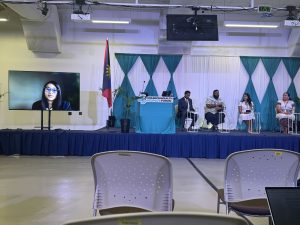
This report records a panel discussion on the International Court of Justice’s 2025 advisory opinion on climate change, and its implications for human rights and state accountability. Held during the Commonwealth People’s Forum in Antigua, the panel brought together Pacific and Caribbean advocates and legal experts to consider how the advisory opinion can be used to clarify state obligations, connect climate change to human rights, and advance accountability for climate harm.
2. Panel Composition
Moderator: Ryan Bachoo
Speakers:
- Abdul Mufeez Shahid — legal and climate justice advocate, engaged in international negotiations and litigation
- Eleala Avanitele — Tuvaluan advocate, board member of the Tuvalu National Climate Action Network
- Sangeetha Lengar — climate mobility specialist (Oxford)
- Asiphe Funda — human rights advocate, joining online from South Africa

3. Overview
Speakers described the ICJ advisory opinion as a significant legal and advocacy tool that clarifies existing state obligations and connects climate change with human rights. They stressed that its value depends on turning legal recognition into practical action — accountability for high emitters, accessible climate finance for frontline communities, inclusive disaster planning, and rights-based governance of climate mobility — while identifying barriers including limited capacity, legal suppression, and weak political implementation.
4. Key Themes
4.1 The advisory opinion clarifies existing law
Abdul Mufeez Shahid addressed the common objection that an advisory opinion lacks legal force. He noted that the opinion was delivered unanimously by the 15 judges of the ICJ; and that the UN General Assembly welcomed and took up portions of it on 20 May, carried by 141 votes.
He emphasised that the Court created no new law, but clarified existing obligations drawn from instruments including the UNFCCC, international human rights law, the Biodiversity Convention and the law on desertification, to which states are already bound. He also recorded that, of relevance to the Commonwealth, three members — South Africa, Nigeria and India — abstained rather than opposed the resolution, South Africa indicating agreement in principle while seeking stronger language on equity and common but differentiated responsibilities.
4.2 Climate change as a human rights issue
Asiphe Funda identified the central legal principle as the recognition that climate change directly affects fundamental human rights, rather than being solely a geopolitical matter. The opinion clarifies that a safe, clean and healthy environment is inherent to the enjoyment of other rights, including the rights to health and life, and that corresponding obligations fall on the state — including states bound under customary international law even where they are not party to the relevant conventions.
Speakers stressed that climate impacts are not felt equally, and that groups including women, children, pregnant people and those with chronic conditions face heightened risk. Accountability, Asiphe Funda argued, should be pursued through national health policy and engagement with health ministries to ensure targeted messaging and interventions.
4.3 Climate mobility and rights-based governance
Sangeetha Lengar set out four findings in the opinion that, for the first time, give climate mobility a footing in the law of state obligation: confirmation that climate change is already causing displacement; an explanation of habitability in the language of human rights; recognition of non-refoulement for people displaced by climate events; and treatment of statehood in light of territorial degradation.
She argued that habitability shifts the focus from borders to “what it takes for a safe, dignified life to continue”, for people whether they stay or move, drawing on the opinion’s description of a safe, clean and healthy environment as a precondition for all human rights (paragraph 393 of the ICJ Advisory Opinion). Rather than await a new framework, she urged states to realise the rights the opinion already recognises.
As a practical model, she cited the Caribbean’s OECS free movement arrangement: after Hurricane Maria in 2017, displaced Dominicans were able to enrol children in school, access healthcare and services, and find work in neighbouring islands without having to prove climate causation — a tool not designed for climate displacement but effective in it.
4.4 Capacity and finance barriers for frontline communities
Eleala Avanitele described frontline institutions operating with limited staff and resources while facing increasingly frequent disasters, compounded by administrative processes and the rigid deadlines of international partners.
Drawing on the “Rise Together” research by the Tuvalu National Climate Action Network, she reported that of approximately US$235 million received by Tuvalu in climate funds between 2012 and 2023, only 18% had reached communities directly. She called for localisation — transferring ownership and capacity to communities and channelling finance through existing structures such as local island councils — and emphasised that investment in people and community matters more than infrastructure alone.
4.5 Accountability and stronger implementation
Abdul Mufeez Shahid identified legal and institutional obstacles to holding governments and major polluters to account. Anti-litigation and SLAPP-style measures, he said, mean that “The only people that can litigate against climate change are the ones who have money” — not those on the front line losing land to rising seas — so that communities find themselves opposing the very institutions meant to protect them. He also noted a decline in mainstream climate reporting, weakening public pressure.
Asiphe Funda pointed to the opinion’s finding that states must act with due diligence to prevent climate harm, using the best available science and adequate environmental impact assessments, and argued that governments should be held to their Nationally Determined Contributions as measurable benchmarks. Abdul Mufeez Shahid observed that the opinion is already informing litigation, advocacy and negotiations, and that governments are notably wary of how it may be applied.
4.6 Fossil fuel phaseout and inclusive climate action
Abdul Mufeez Shahid urged a return to the explicit language of “fossil fuel phaseout” rather than its dilution into “energy transition,” recalling the opinion’s statement that the production, extraction, licensing, consumption and subsidy of fossil fuels may constitute a violation of international law, and criticising reliance on carbon offsetting as a false solution.
He stressed that disaster planning must account for intersecting vulnerabilities, describing trans and queer people excluded from aid, placed in unsafe binary shelters, or scapegoated after disasters, and urged governments to “count people in their diversity” in disaster risk reduction and response.
5. Discussion and Audience Engagement
A rolling audience poll asked whether governments had done enough to advance the 2025 opinion; responses pointed to insufficient support for community resilience and failures to protect land rights.
A question from the audience raised the increase in eye disease — cataracts, macular degeneration and glaucoma — linked to UV exposure and dusty conditions. Panellists acknowledged climate change as a “threat multiplier” that worsens existing inequalities, and recommended using national health policy and ministries of health to develop targeted protections, including for pregnant women.
A comment from the Eastern Caribbean Alliance for Diversity and Equality pressed the panel on intersectionality — connecting climate work to food security, housing, health, gender-based violence and the inclusion of LGBTQ+ communities — and on ensuring that civil society continues to create space for those not usually at the table.
6. Conclusion
In closing reflections, speakers called for a shift from legal recognition to responsibility. Eleala Avanitele framed this as knowing where each advocate can act and including everyone in the response. Sangeetha Lengar urged states to give effect to the opinion and to begin governing climate mobility so that all can enjoy the safe, clean environment the opinion treats as a precondition for other rights. Abdul Mufeez Shahid concluded that the world must stop treating the opinion as advice and start treating it as instruction, applying the Court’s words with precision, measuring every climate decision against the lives it is meant to protect, and listening to the young advocates who brought the case.
Lenny Rahman, CLA Council Member for Brunei