


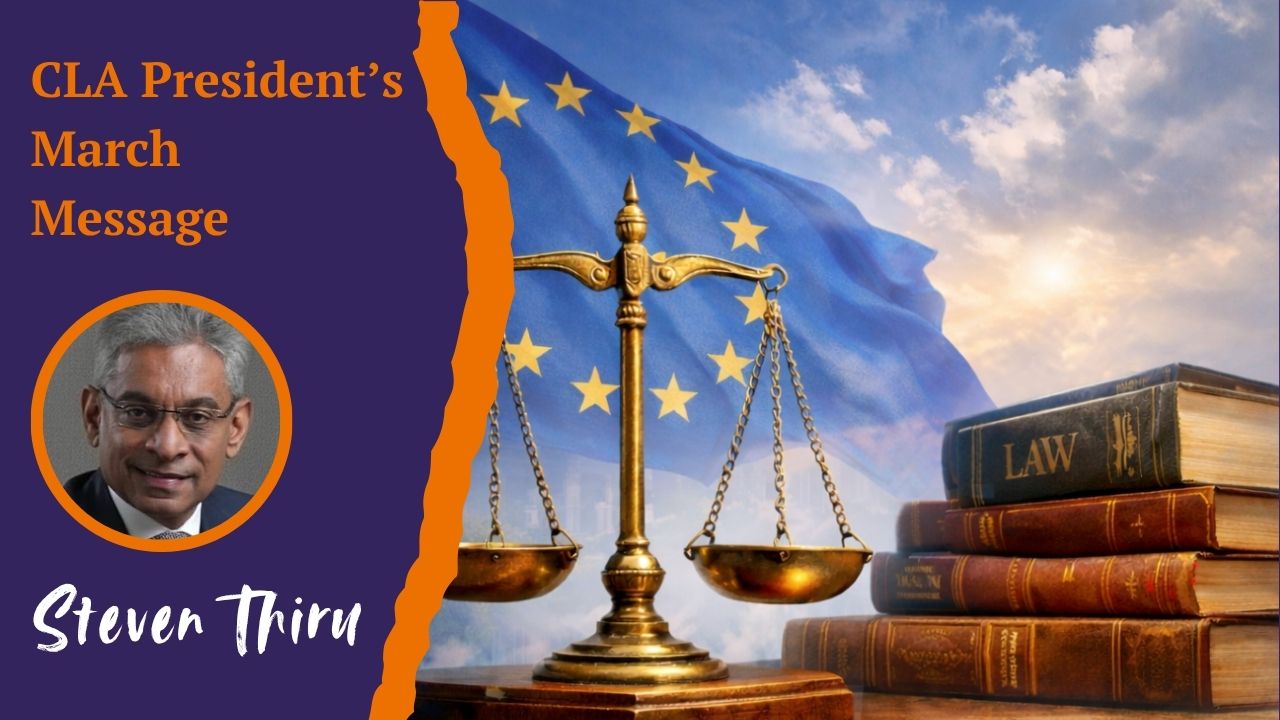
CLA News / Safeguarding the Legal Profession in the Commonwealth: The Luxembourg Convention by CLA President Steven Thiru

The independence of the Bar is as valuable to the client as it is to the public welfare. To the client, it gives an assurance of such accuracy as knowledge and skill can contribute; to the community, it gives the service of applying the law in the manner in which the law is intended to act. It is independence that makes the barrister essential to the administration of justice according to law. Independence that cannot be bought in a market; independence that will not be bartered for money, or for privilege, status or favour or even for a momentary success. This is the characteristic that, more than any other, stamps the Bar as a profession and not a service industry.
The Hon Sir Gerard Brennan AC KBE, Former Chief Justice of Australia (18 August 1996)
Independence of the Bar and the Imperative of Protection
As Justice Brennan emphasised in 1996, the independence of the Bar is essential not only to the client but to the public welfare, ensuring both the integrity of legal representation and the proper functioning of the law itself. Such independence must remain inviolate: it cannot be compromised for financial gain, status, or expediency. It underpins the administration of justice and sustains the rule of law. Protecting lawyers from intimidation or interference is therefore not only a professional concern, but a societal imperative — one that recent events around the world starkly illustrate.
On 13 February 2026, attorney-at-law Buddhika Mallawa Arachchi and his wife were shot dead in broad daylight in a supermarket car park in Akuregoda, Sri Lanka, apparently by two assailants who fled the scene. Authorities are examining whether the attorney’s professional engagements, including past representation of clients allegedly linked to organised crime, may have been a factor in the killing. The Commonwealth Lawyers Association (CLA) condemned the attack as part of a broader threat to lawyers, and called for urgent investigation, accountability, and stronger protections for the legal profession in Sri Lanka.
On 12 February 2026, prominent Tunisian lawyer Ahmed Souab was arbitrarily detained, with Human Rights Watch reporting that the charges against him were linked to his defence of political opponents and involvement in human rights cases. While the allegations remain contested, this unjustified detention underscores the vulnerability of legal practitioners who represent unpopular or politically sensitive clients, and how such actions can erode public confidence in justice systems.
These disturbing incidents are far from isolated or contemporary phenomena. History is replete with examples of lawyers being threatened, harassed, or even killed for fulfilling their professional obligations and upholding the rule of law. The worldwide legal community formally recognises these risks by commemorating the International Day of the Endangered Lawyer on 24 January each year.
By observing this day, the profession underscores the global prevalence and persistence of such attacks, and that without clear, comprehensive, and institutionalised protection of the legal profession, the very foundations of justice and societal stability are imperilled. Governments and public authorities must therefore adopt and enforce tangible, uncompromising measures to safeguard the independence of legal practitioners, ensuring that those who defend the law and the rights of others can do so free from fear, interference, or reprisal. The survival of the rule of law depends upon nothing less.
Tracing the Roots of the Luxembourg Convention
The Council of Europe Convention for the Protection of the Profession of Lawyer — commonly referred to as the Luxembourg Convention — marks a key step in protecting the rule of law and access to justice by establishing a legal framework addressing threats and interference with lawyers’ duties.
The treaty builds upon earlier normative frameworks; its origins are best understood within the wider landscape of international initiatives dedicated to safeguarding the independence of the legal profession and maintaining the integrity of the rule of law. Most notably, the United Nations Basic Principles on the Role of Lawyers established that lawyers must be able to perform their professional functions “without intimidation, hindrance, harassment or improper interference”. Despite their significance, these principles lack legal binding force and have proven ineffective in addressing persecution. Commentators have observed that the absence of enforceable international mechanisms has historically undermined protections for the independence of the legal profession.
In 2017, the Council of Bars and Law Societies of Europe (‘CCBE’) initiated advocacy for a new convention in response to growing reports of threats and attacks on legal professionals. The project was driven by CCBE’s European Convention Working Group, and the proposal subsequently gained institutional traction within the Council of Europe. The Convention was formally adopted by the Committee of Ministers on 12 March 2025, and opened for signature in Luxembourg on 13 May 2025.
From Principle to Protection: The Luxembourg Convention in Practice
The Convention represents the first binding international treaty specifically designed to safeguard the independence, professional rights, and security of lawyers. Essentially, it affirms that lawyers and their professional associations have the right to fulfil their professional activities independently, free from discrimination, improper interference, or exposure to attacks, threats, harassment, or intimidation.
A central component of this instrument concerns the protection of the professional rights of lawyers. States Parties are required to ensure, among others, that lawyers can provide legal advice, assistance, and representation freely, including in matters involving the defence of human rights and fundamental freedoms. Measures must be put in place so that lawyers enjoy freedom of expression, and do not face negative repercussions for being identified with their clients or their clients’ causes. States Parties must also guarantee lawyers access to and confidential communication with clients, as well as effective participation in legal proceedings. In addition, the treaty provides that lawyers shall not incur civil or criminal liability for statements made in good faith in the course of representing their clients, thereby safeguarding advocacy. Protective measures must be instituted and enforced in situations where lawyers are deprived of their liberty or where they are the subject of a search or seizure.
The Convention also emphasises the importance of an institutional framework that guarantees professional associations, such as bar associations and law societies, operate as independent and self-governing bodies, shielded from external interference. States Parties must ensure that these entities are able to carry out their professional functions without being targeted or improperly hindered, including representing the interests of lawyers, defending the independence of lawyers and their societal role, developing professional standards, and providing input in consultations regarding legal reforms affecting the profession.
In addition to these and other substantive guarantees, the Convention introduces protective and oversight mechanisms designed to ensure effective implementation. States Parties must undertake an effective investigation if lawyers or their professional associations are targeted, where the prohibited conduct may constitute a criminal offence. The Group of Experts on the Protection of the Profession of Lawyer (‘GRAVO’) is charged with monitoring compliance, and evaluating implementation through reporting procedures, country visits, and recommendations.
Taken together, the Convention’s provisions elevate long-standing principles concerning the independence of the legal profession into binding obligations on States Parties, while also setting a global normative standard that can guide and influence the conduct of non-States Parties. In doing so, they strengthen international protections for lawyers and reinforce the institutional foundations necessary for the rule of law.
The CLA Declaration on the Luxembourg Convention: Vision, Solidarity, and Action
In its Declaration on the Adoption and Promotion of the Convention on the Protection of Lawyers of 19 January 2026, the CLA emphasises that “an independent legal profession is a fundamental pillar of a free and democratic society, and that without the safety and independence of lawyers, access to justice is illusory”.
The CLA unequivocally endorses the Convention and considers it as a necessary legal response to the growing risks faced by lawyers exercising their professional responsibilities. It views the treaty as a significant development in legal protection worldwide, describing it as “the new international gold standard” for protecting the independence and physical security of lawyers. The Convention is designed to be universal and fit for jurisdictions with differing legal traditions, including common law systems. This makes it highly relevant to Commonwealth countries.
The CLA Declaration affirms that the safeguards enshrined in the Convention transcend regional values and constitute fundamental requirements for the administration of justice. The CLA’s commitment is not intended to remain at the level of endorsement alone. Its broader position is that the treaty should serve as an emerging global benchmark for the safety and independence of the legal profession — one with relevance to all jurisdictions committed to the rule of law. The CLA calls on Commonwealth nations to move towards alignment with the standards established by the Convention, and to consider acceding to the treaty. To that end, the CLA envisages an active role for itself in advancing this instrument, by promoting it among bar associations and law societies throughout the Commonwealth and helping to identify the most effective route for engagement with the Council of Europe.
Pertinently, the CLA urges domestic legislative review in accordance with the Convention and advocates for more robust oversight mechanisms. The thrust of the CLA’s action plan is therefore not merely declaratory but operational — to build awareness, foster institutional support, and lay the groundwork for eventual accession to and implementation of the treaty across the Commonwealth as a universal requirement for protecting the legal profession.
The CLA stands in solidarity with lawyers facing persecution, and calls on Commonwealth nations — and the international community — to transform the “Luxembourg Standard” from principle into practice. All lawyers and their professional associations must be able to discharge their professional duties safely and independently, without fear of reprisal, so that justice, the rule of law, and democratic governance are truly protected everywhere.
Steven Thiru
President
Commonwealth Lawyers Association
20 March 2026
Steven Thiru records his appreciation to Ng Wan En, Loh Chee Ming, Justyn Avynash Jiwa, and Allysha Anne Ronald (pupils in the chambers of Steven Thiru); Jaishanker Sadananda; and Chin Oy Sim for their assistance in preparing this article.