

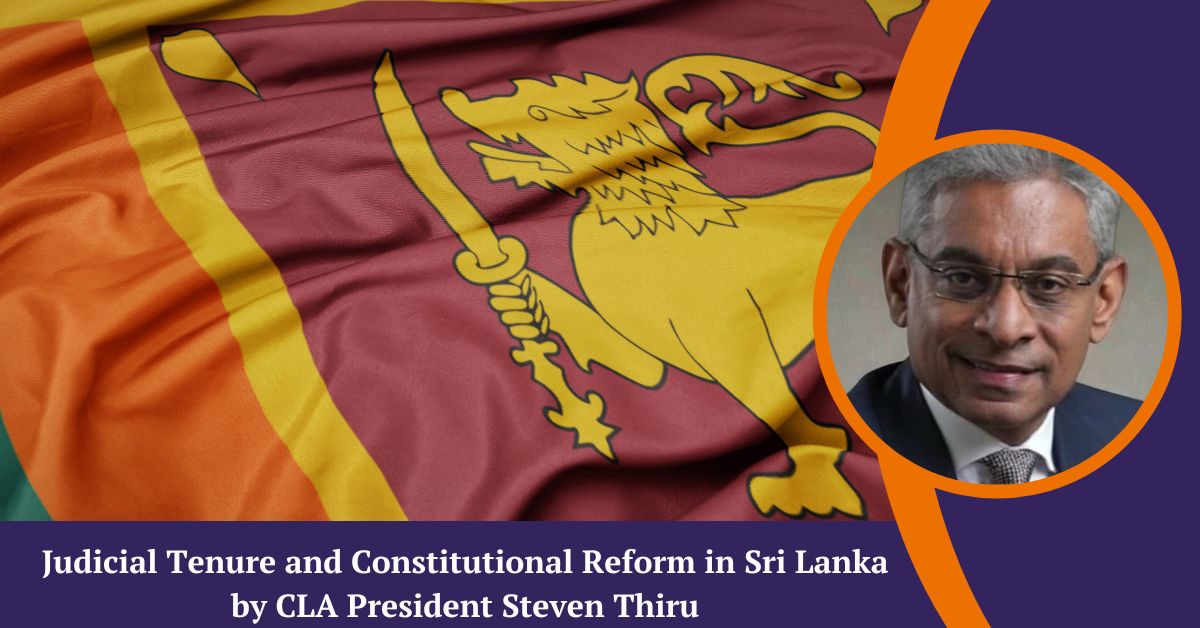
CLA News / Speech: Judicial Tenure and Constitutional Reform in Sri Lanka by CLA President Steven Thiru

This speech was delivered online by Steven Thiru on 4 July 2026 at the Bar Association of Sri Lanka’s public forum on the position of the Bar in relation to amending the Constitution to extend the retirement age of judges including of the Supreme Court and the Court of Appeal.
Mr. Rajeev Amarasuriya, President of the Bar Association of Sri Lanka (‘BASL’) and distinguished members of the Executive Committee of the BASL,
Mr. Yap Teong Liang, President of LAWASIA,
Mr. Upul Jayasuriya, Past President of the BASL and Council Member of the Commonwealth Lawyers Association (‘CLA’),
Members of the Bar of Sri Lanka,
Ladies and gentlemen,
It is a privilege to address you today, albeit from outside your shores. I would have very much liked to be in Colombo for this forum, but my court commitments have regrettably prevented my attendance. Please accept my apologies.
The CLA and I are honoured to have been invited to address you. As an organisation dedicated to upholding the rule of law and protecting the independence of the Bar and the judiciary, the CLA is acutely conscious and alive to the importance of this public forum and the critical issue of the retirement age of judges in Sri Lanka, including those of the Supreme Court and the Court of Appeal.
The primary duty of Bar associations and law societies across the Commonwealth is to be custodians and defenders of the rule of law, and to serve as sentinels of justice. An independent Bar is compelled by its collective conscience and its constitutional mandate to speak without fear or favour; without regard to its own interest; and with clarity, precision, and unwavering resolve when the rule of law is tested or imperilled.
This responsibility of an independent Bar is a foundational imperative that is recognised by the global legal community. As explicitly reaffirmed in the 2026 CLA Declaration on Adoption and Promotion of the Luxembourg Convention on the Protection of Lawyers, we must recognise that “an independent legal profession is a fundamental pillar of a free and democratic society, and that without the safety and independence of lawyers, access to justice is illusory”.
The BASL is a shining example of an independent Bar, and throughout its history the BASL has been peerless in its advocacy for the rule of law, and particularly in the preservation and promotion of the independence of the judiciary in Sri Lanka. Today, as Sri Lanka faces yet another challenge to judicial independence in the form of the proposed extension of the mandatory retirement age of judges of the superior courts, it is entirely in keeping with its longstanding role that the BASL is at the forefront of the discourse on this controversial issue.
The Constitutional Context
Under the current constitutional architecture of Sri Lanka, the mandatory retirement age of superior court judges is fixed. Article 107(5) of the Constitution states that “[t]he age of retirement of Judges of the Supreme Court shall be Sixty-five years and of Judges of the Court of Appeal shall be Sixty-three years.”
The government’s reported legislative intention to move a Constitutional Amendment Bill to enhance these retirement ages is at the epicentre of the present controversy.
At the outset, it must be noted that the CLA does not, in principle, object to increasing the mandatory retirement age of judges. Across the globe, changing demographic realities, advancements in public health, and extended life expectancies have triggered legitimate institutional debates regarding the optimal age limit for judicial tenure. Many jurisdictions have recognised that senior jurists at 65 or 66 years of age remain at the zenith of their intellectual, analytical, and professional capabilities.
A compelling, positive illustration of this principle can be seen in the United Kingdom (‘UK’). In March 2021, the UK Ministry of Justice announced a legislative reform to raise the mandatory retirement age for all judges, magistrates, and coroners from 70 to 75 years. This change was deliberately enacted to reflect societal improvements in life expectancy and to systematically retain invaluable judicial expertise. Crucially, this measure was not an overnight political intervention designed to target specific individuals or influence pending rulings. It was preceded by an extensive public consultation that garnered over 1,000 comprehensive responses from stakeholders, including the judiciary, magistracy, and legal profession.
Because it was handled as an open, prospective, and non-partisan institutional process, the reform actively preserved public trust, with independent analysis confirming it had no adverse impact on public confidence in the judiciary, which remained consistently high at 84 per cent. It remains a compelling example of how a mature democracy handles the evolution of judicial tenure: through thorough consultation, transparent justification, and an unyielding commitment to institutional stability.
Hong Kong provides another relevant example. In 2019, structural reforms extended the statutory retirement age of judges from 65 to 70 years to address judicial manpower shortages and retain experienced jurists. However, the conduct of the then-Chief Justice of the Court of Final Appeal, Geoffrey Ma, provided a glowing example of judicial propriety and institutional integrity. While the newly passed law legally empowered him to extend his own tenure by an additional five years, Chief Justice Ma deliberately and publicly chose to vacate his office upon reaching his originally mandated retirement age of 65 in January 2021.
He stated unequivocally that retiring exactly when he was originally scheduled to do so was in the “best interests of the Judiciary”, emphasising that orderly succession planning and a healthy rotation of leadership must always take precedence over individual longevity on the bench. By declining to let a broad institutional initiative serve as a vehicle for his own personal gain, Chief Justice Ma ensured that a forward-looking institutional policy could never be misconstrued as an opportunistic or self-serving manoeuvre, thereby insulating the judiciary from political scepticism.
Ladies and gentlemen,
The vice of the current proposal in Sri Lanka does not lie in the abstract numerical value of 68 or 70 years. The profound concern lies in the timing, the manner, the politicised context, and the particularised application of this proposed reform.
When a sitting executive or legislature attempts to alter the tenure of sitting judges during a period of acute political sensitivity or active judicial determination of politically charged state matters, the amendment ceases to be a systemic structural reform. Instead, it assumes the hallmarks of an ad hoc, piecemeal, and individualised intervention. It is this fundamental distinction between institutional evolution and contextual manipulation that is objectionable.
An instructive example of how such an amendment can backfire occurred in Zimbabwe in 2021. The Constitution of Zimbabwe Amendment (No. 2) Act, which amended Section 186 of the Constitution, was hurried through Parliament to raise the mandatory retirement age for senior judges from 70 to 75 years.
Crucially, this amendment was fast-tracked without meaningful public consultation, just as the sitting Chief Justice, a jurist widely viewed as sympathetic to the executive, was reaching his 70th birthday. The legal community reacted with immediate outrage, with the Young Lawyers Association of Zimbabwe (‘YLAZ’) launching an urgent legal challenge. In a landmark ruling, the High Court of Zimbabwe in the case of Kika v Minister of Justice & Ors; YLAZ v JSC & Ors, HH 264-21, issued a declaratory order stating that the extension could not legally apply to sitting judges, effectively declaring that the Chief Justice had retired by operation of law.
Though the state appealed, and the Constitutional Court ultimately overturned the High Court’s ruling, the decision inevitably fuelled perceptions that the country’s highest court had acted to preserve the tenure of its own Chief Justice under a tailor-made amendment. That, in turn, fundamentally undermined institutional credibility and left the judiciary heavily compromised by perceptions of executive influence.
As Sri Lanka stands at this constitutional crossroads, the country’s leadership must heed the sobering lesson of the Zimbabwean crisis: when a ruling government alters the rules of judicial longevity midstream, the damage to the legal fabric is severe.
If Sri Lanka proceeds with an ad hoc, non-transparent extension of tenure for its superior court judges without a broad consultative process, it risks plunging its legal system into a similar crisis of legitimacy. A structural policy matter must not give rise to the perception that it is an intervention directed at serving judges; to do so would fundamentally invite public cynicism, compromise the appearance of judicial neutrality, and shatter the very institutional stability that is to be protected.
Public Confidence and Judicial Independence
In our statement issued on 11 June 2026, the CLA aligned itself with the grave concerns articulated by the BASL. Our focus converges sharply on a well-established tenet of public law: public confidence is the judiciary’s ultimate currency. As Alexander Hamilton once wrote, “[t]he judiciary … has no influence over either the sword or the purse”, underscoring that the judiciary possesses neither coercive force nor control over public finances. Its legitimacy therefore rests on public trust and confidence. Once lost, they are not easily restored. The judiciary will then be consigned to prolonged periods of scepticism, doubt, and even ridicule.
The constitutional guarantee of judicial independence exists not for the personal comfort or aggrandisement of individual judges, but as a protective shield for the public against the arbitrary exercise of state power.
Therefore, it is a cardinal principle that the judiciary must not only remain independent in fact, but must also manifestly be seen to be independent. The slightest shadow of influence, favour, accommodation, or undue executive-judicial alignment erodes the very bedrock of the rule of law. As the BASL forcefully pointed out to His Excellency, the President of Sri Lanka, extending the retirement age of sitting judges at this particular juncture in Sri Lanka’s constitutional history will inevitably be interpreted by the public as a blatant attempt to interfere with the natural rotation, composition, and independence of the bench.
When an amendment changes the terms of office of currently serving judges, it creates the immediate appearance of a benefit conferred by the political branches of government upon individual members of the judiciary. The public is left to ask a deeply corrosive question: Is this extension a reward for past judicial accommodation, or is it an inducement for future institutional compliance? The moment that question becomes a plausible one in the minds of reasonable citizens, the institutional integrity of the superior courts is compromised.
Quite apart from this is the potential loss of morale among more junior members of the judiciary, who may perceive the extension of the mandatory retirement age as stalling their career progression. That, in itself, would be another blow to judicial independence.
Constitutional Reform Must Follow Due Process
Constitutional instruments are sacred social compacts designed to provide structural permanence, stability, and predictability to the state. They are expressly engineered to withstand the transient political winds of passing administrations.
The alteration of fixed judicial tenures through piecemeal, ad hoc amendments strips the Constitution of its institutional sanctity. It reduces an enduring constitutional text to a tool of political convenience. International legal norms dictate that any meaningful constitutional reform affecting the judiciary must be characterised by strict adherence to democratic due process. This demands extensive and transparent stakeholder engagement, rigorous public debate, and formal consultation with the institutional Bar and civil society.
In the present context, introducing a sweeping revision to judicial tenure without open and transparent deliberation undermines the democratic framework. It bypasses the necessary checks and balances that prevent executive overreach. In this regard, the Colombo High Court Lawyers’ Association rightly observed that modifying these provisions without a compelling, broadly accepted constitutional justification represents a grave impropriety. It stalls the natural progression of judicial careers, prevents the timely infusion of new judicial talent, and destabilises the established hierarchy of the courts.
Commonwealth Standards and Comparative Practice
To fully appreciate the gravity of the current controversy, we must measure it against established global standards and norms. The Commonwealth (Latimer House) Principles on the Three Branches of Government are a seminal statement endorsed by Commonwealth Heads of Government. Principle IV explicitly provides that “[a]n independent, impartial, honest and competent judiciary is integral to upholding the rule of law, engendering public confidence and dispensing justice.”
Furthermore, the Commonwealth Bar Leaders’ own 2023 Declaration on Preserving and Strengthening the Independence of the Judiciary and on Ensuring the Independence of the Legal Profession (‘Goa Declaration’) reinforces this mandate, affirming that the independence and impartiality of the judiciary must be actively protected and upheld by governments through transparent domestic laws and non-discriminatory policies. Good practice requires that judicial appointments be permanent or subject to a clearly fixed retirement age established prior to appointment.
Judges must never serve, or appear to serve, at the executive’s pleasure, nor should their terms of office be subject to sudden fluctuations resulting from shifts in parliamentary majorities.
Judicial Independence Under Threat
This insidious pattern of executive interference is not unique. As the CLA has witnessed with deep alarm over the past two years, the independence of the judiciary is facing an unprecedented assault across multiple continents. Here are some stark examples.
We saw this structural aggression manifest in Kiribati with the arbitrary removal and deportation of High Court Judge David Lambourne in 2024, following an investigative tribunal process that the CLA condemned for a persistent lack of due process.
We witnessed it again in the Maldives in 2025, where the sudden suspension of Supreme Court Justices Dr. Azmiralda Zahir, Mahaz Ali Zahir, and Husnu Al Su’ood triggered protests against the executive’s attempts to bend the apex court to its will during active constitutional challenges.
In Ghana, the controversial suspension and eventual removal of Chief Justice Gertrude A. E. S. Torkornoo in 2025 forced the highly respected jurist to seek emergency redress before the Community Court of Justice of the Economic Community of West African States (‘ECOWAS’), a tragic testament to what happens when constitutional safeguards for tenure are wilfully cast aside.
We have also witnessed unprecedented, highly personalised verbal and political attacks targeted directly at the independence of the United States Supreme Court and lower federal benches. When heads of state openly denigrate judges as partisan adversaries or threaten the structural composition of courts to guarantee favourable political outcomes, the message sent to the global populace is unmistakable: the judiciary is no longer an independent arbiter of the law, but a prize to be captured.
Unfortunately, this erosion of judicial safety is not confined within national borders; it has brazenly crossed into the international arena. Just yesterday (3 July 2026), widespread reports highlighted an escalation in the Trump administration’s campaign of economic and legal intimidation against the International Criminal Court (‘ICC’) in The Hague. In a publicly released letter to the ICC President, the administration vigorously renewed its criticism, declaring any exercise of international jurisdiction over citizens of states that are not parties to the Rome Statute an “illegitimate” and “lawless” affront to state sovereignty.
This rhetorical assault follows a deeply troubling pattern of executive overreach, including aggressive economic sanctions levied directly against international judges and prosecutors to punish and coerce their judicial decision-making. The crisis has reached such an extraordinary flashpoint that just days ago, three sitting ICC judges felt compelled to file a lawsuit in the United States District Court for the Southern District of New York to challenge sanctions they contend are unlawful.
When a major superpower deploys raw geopolitical clout and punitive financial measures to target the very jurists tasked with upholding international law, it shakes the broader legal order to its core, signalling that no judge, anywhere in the world, is immune from political retaliation.
As members of the wider legal community, we cannot afford to be passive observers while the essential pillars of our respective democracies are dismantled. There must be an unyielding collective vigilance and absolute institutional resolve within the Bar and civil society to resist any measure that makes a judge’s security of tenure dependent on political pleasure or parliamentary majorities.
A Call for Constitutional Prudence
Distinguished colleagues, the CLA stands in absolute solidarity with the legal profession and the people of Sri Lanka. We cannot — and will not — look away when the pillars of the rule of law in your country are subjected to structural destabilisation.
We call upon the Government of Sri Lanka to:
- Refrain from introducing, and withdraw, any piecemeal or ad hoc amendments to Article 107 of the Constitution that seek to alter the retirement parameters of sitting judges;
- Commit fully to an open, transparent, and comprehensive process of public and stakeholder consultation before introducing any broad structural reforms to the justice sector; and
- Desist from taking any unilateral legislative steps that risk undermining public confidence in the ultimate independence, impartiality, and neutrality of the superior courts.
To the BASL, we commend your courageous and principled defence of the independence of the judiciary. An independent judiciary is not a luxury for stable times; it is an absolute necessity at all times, and particularly in moments of controversy. We must therefore guard judicial independence with our collective will, our professional courage, and our resolute fidelity to the rule of law.
Thank you.
Steven Thiru
President
Commonwealth Lawyers Association
4 July 2026 (Updated on 17 July 2026)
Steven Thiru records his appreciation to Jaishanker Sadananda and Chin Oy Sim for their assistance in preparing this speech.