

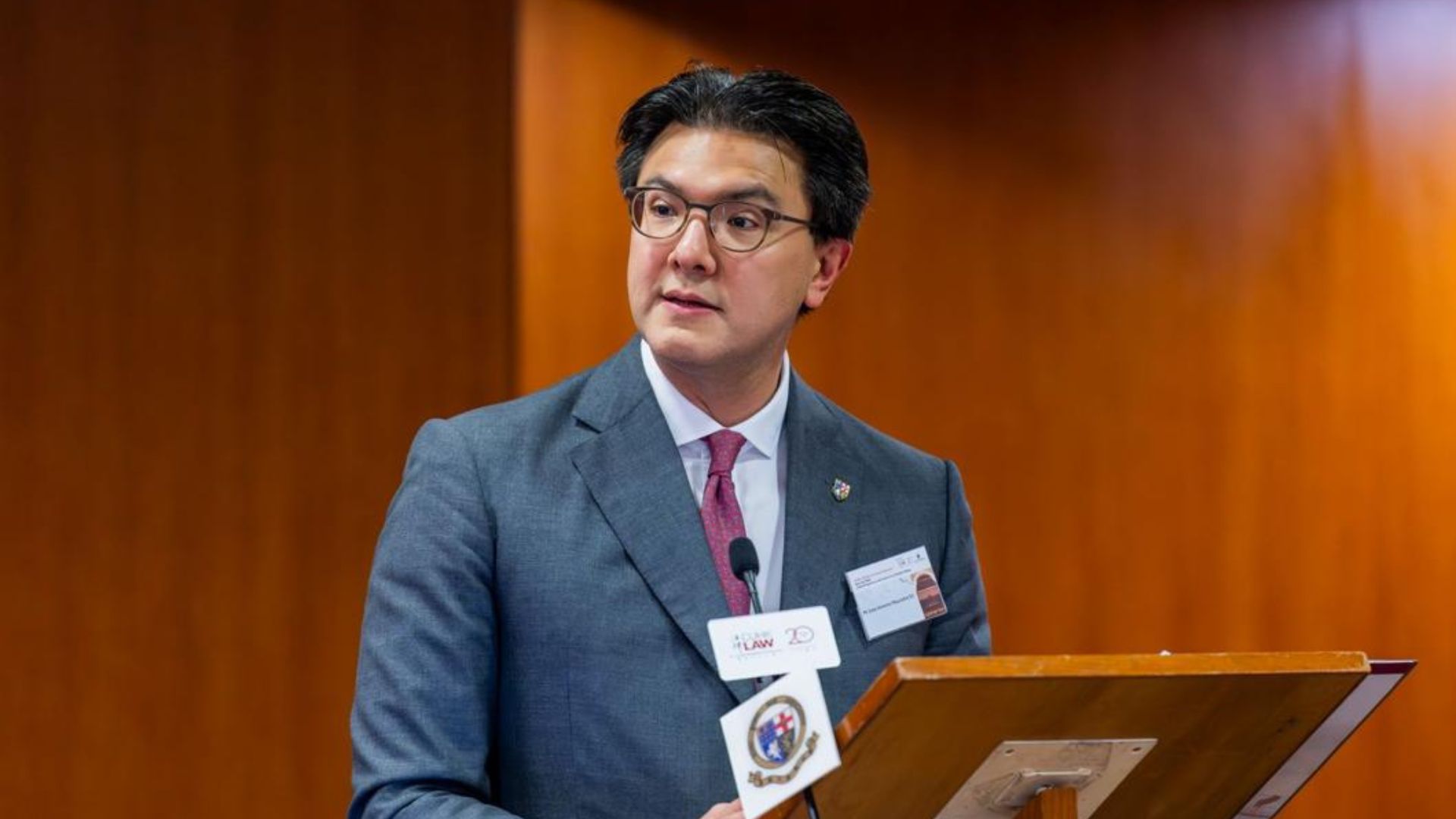
CLA News / Welcome Address at the HKBA and the CUHK Law Symposium “Jury on Trial: Critical Perspectives on the Future of Lay Decision-Making” by José-Antonio Maurellet, SC

Jury on Trial: Critical Perspectives on the Future of Lay Decision-Making
Welcome Address
Honourable Judges, Prof. Hargreaves, members of the Faculty, distinguished guests, colleagues, and students:-
1. On behalf of the HKBA which is co-organizing this event together with the faculty of law of the Chinese University, I would like to welcome you all. The topic of this symposium is definitely topical – the role of jury trial in our legal system.
2. No doubt many who attend this symposium would be interested in the substantive aspects of jury trial – its merits, or de-merits, as compared with trial by judges. This is of course an interesting topic admitting both theoretical and empirical arguments. This will be canvassed in detail by the many distinguished speakers presenting today.
3. However, what I am perhaps more interested in is the role of jury trial in the public’s perception of the rule of law; and the related question of what a society says about itself when it invites ordinary people into the most solemn room in the land— the courtroom — and asks them to decide the facts upon which a person’s liberty may depend.
4. In my view, the social contract whereby the administration trusts its own people to adjudicate matters of the gravest kind is itself an invaluable dimension of the rule of law.
5. The thesis is simple. The jury is not a cinematic prop, though cinema has made it famous. The institution itself has a longer memory. It came to Hong Kong in 1845. It has been with us ever since. Article 86 of the Basic Law is clear: “The principle of trial by jury previously practised in Hong Kong shall be maintained.”. Our Court of Appeal has described jury trial as a tradition deeply rooted in the common law, “an integral and indispensable feature of the criminal justice system”, entrenched in that Article.
6. Lest it be misunderstood, jury trial is not a free-standing constitutional right available to every accused person in every case – something our Courts had made clear. In the same vein, valuing the jury system does not mean that justice is not served where there is no jury. Indeed, most types of criminal cases in Hong Kong have never been tried by a jury. Magistrates and District Judges, sitting alone, dispose of the vast majority of such cases, and they do so with skill and integrity. A fair trial, as our Court of Appeal has observed, is not synonymous with a jury trial.
7. Yet some meaning must be given to the principle enshrined in the Basic Law – and a principle that is never used, or used only when it is convenient, is a principle in name only. It is against this background that the debate on the future of jury trials in Hong Kong should be conducted.
8. Moving back to my core thesis, why, then, does the jury still matter, if a professional judge can try a case fairly?
9. The rule of law is not a matter for the legal professions only, it exists for the public.
10. When seven Hong Kong residents are sworn, sit through the evidence, receive the judge’s directions on the law, and return a verdict, two things happen at once.
a. First, the facts are found by people who live under the same laws as the accused.
b. Second, the community at large sees that the state has not reserved the entire administration of criminal justice to officials. It has trusted citizens with a share of it.
11. That trust is visible. It is intelligible. A member of the public who will never sit on a jury, and who may never set foot in the High Court, can still understand the idea: if I, or someone I love, were charged with the most serious of crimes, the question of guilt would not rest not on an elite, professional minds, but on the pooled judgment of the common people, “just like us”.
12. Some of you in this hall will, in due course, be those people. Jury service is not a fate reserved for others. It is one of the few civic duties in which a student of engineering, of medicine, of history may sit in judgment on the same evidence, under the same oath.
13. The New Zealand Law Commission, whose analysis our own Law Reform Commission had adopted, put the point with unusual candour. The jury’s primary task is to find facts. But it also “plays an important role in legitimising and maintaining public confidence in the criminal justice system.” To maximise that confidence, juries should “appear to be, and in fact be, impartial and representative of the community.”
14. In this context, it is apt to note the choice of words: the words “appear to be” are given as much prominence as the words “in fact be”. Perception is not the enemy of justice. Quite the contrary.
15. In a courtroom, appearances matter, because a justice system that is fair only in the eyes of the professionals who run it has already begun to lose the people it serves. People obey the law more readily, and accept outcomes they dislike more readily, when they believe the process that produced those outcomes was theirs — not something done to them by a small group of experts. Trust means that citizens would, in the words of H.L.A. Hart, not merely comply by way of coercion, but by “accepting” the law and taking an “internal point of view” of it. In other words, rather than complying simply because of predicted punishment, those who take an “internal point of view” adopt a practical attitude of accepting legal rules as shared standards of conduct and justification – which in turn motivates compliance.
16. Surveys in England and Wales have, for a generation, told the same story. The right to trial by jury has ranked at the very top of the public’s list of rights thought worthy of constitutional protection. In one Bar Council and Law Society survey, more than 84 per cent of the public trusted a jury to come to the right decision, and regarded trial by jury as fairer than trial by a judge alone. The substantive truth may well differ, but where perception is concerned, the customer must be right.
17. On this point, it is notable that not so long ago in December 2025, the Four Bars of England and Wales, Ireland, Northern Ireland and Scotland issued a joint statement. They did so in response to a proposal in England and Wales to restrict the right to jury trial, advanced as a remedy for delay in the criminal courts. I am not here to conduct a commentary on another jurisdiction’s legislative programme. I am here because the Four Bars, speaking with one voice, articulated something that belongs to the whole common law family –and I quote :
“The curtailment of jury trials has predictable negative consequences, including undermining the public’s trust and confidence in our criminal justice systems. Trial by a jury is long established and respected throughout the common law world for its veneration of democratic ideals, its age, gender and ethnic inclusiveness, and its respect for citizens’ and judges’ roles in the administration of justice. Jurors provide an accumulation of life experience which marginalises extreme or unrepresentative views and, through the majority, delivers balanced and rounded decisions on behalf of the society from which its members were drawn.”
18. This passage is notable for what it starts with – not that juries never err, or that they deliver better substantive justice – but on the need to maintain the public’s trust and confidence in the criminal justice system. They honoured, in the same breath, the citizen and the judge. That is the architecture of a mature legal order: the judge is master of the law; the jury is the community’s presence in the finding of fact; neither is diminished by the other.
19. The same point is made by. Sir William Holdsworth. The jury, he wrote, “tends to make the law intelligible by keeping it in touch with the common facts of life.” Rules of law “must struggle for existence in the strong air of practical life.” The jury has, for centuries, been “constantly bringing the rules of law to the touchstone of contemporary common sense.”.
20. At the end of the day, a confident legal system would not fear the judgment of its people in the jury box. It uses that judgment. It says, in the most practical way available to a legal system: we trust you. We trust you with evidence. We trust you with the difference between suspicion and proof. We trust you, after proper direction, to say whether the prosecution has made you sure.
21. That is not a romantic claim about the wisdom of crowds. It is a claim about the character of the state. The jury is an unusual area where the relationship between government and governed is not merely regulatory, but reciprocal. The Government asks something onerous of the citizen — time, attention, an oath. In return, it confers something worthy and rare: a share in the administration of justice.
22. Professor Michael McConville, writing of the Hong Kong jury, called it “a core political institution symbolizing the commitment of the state to democratic, representative and participatory forms of government.” He added that, in a real sense, “whilst applicable to only a small minority of cases, jury trial acts as some restraint upon both the cult of professionalism and the centrifugal tendencies of the strong state.” I would put the same thought in less academic language. The jury keeps the criminal law from becoming a conversation that lawyers have amongst themselves only.
23. Ladies and gentlemen, the rule of law is often described as a set of constraints upon power. It is that. But it is also a relationship of confidence: confidence that disputes will be decided openly, according to known laws, by independent courts upon evidence. The jury is one of the ways that relationship is made flesh. It is a strength, not a weakness. Our task in all jurisdictions is to make it work, as our constitution demands, however challenging this may seem.
24. Thank you.
José-Antonio Maurellet, SC
Chairman
Hong Kong Bar Association
9 September 2026