
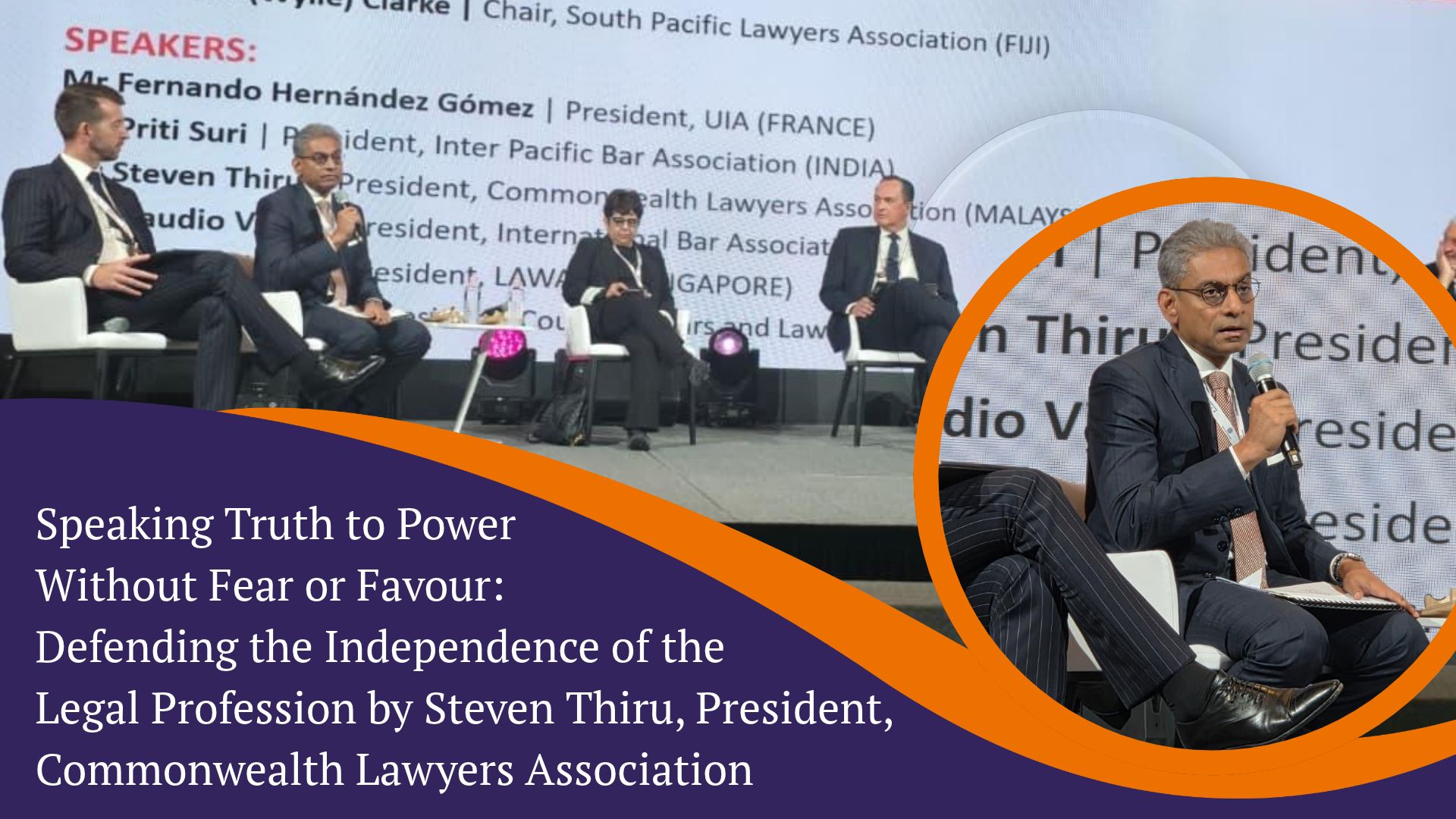
CLA News / Speaking Truth to Power Without Fear or Favour: Defending the Independence of the Legal Profession by Steven Thiru, President, Commonwealth Lawyers Association

This is an updated version of remarks made by CLA President Steven Thiru on 14 September 2026 at the International Bar Leaders Forum titled ‘Is the Independence of the Legal Profession under Threat in the Modern Age?’, which took place at the 39th LAWASIA Annual Conference held from 14 to 16 September 2026 in Seoul, South Korea.
The International Legal Profession: A Common Front
Thank you, Mr Wylie Clarke, Chair and President of the South Pacific Lawyers Association, for your generous introduction.
I wish to also acknowledge my fellow panel members in this forum: Mr Fernando Hernandez, President of the International Association of Lawyers (‘UIA’); Ms Priti Suri, President of the Inter-Pacific Bar Association; Mr Claudio Visco, President of the International Bar Association; Mr Roman Završek, President of the Council of Bars and Law Societies of Europe; and Mr Yap Teong Liang, President of LAWASIA.
It is a privilege to be on this panel of eminent international Bar leaders representing leading international law organisations. The Commonwealth Lawyers Association (‘CLA’) thanks LAWASIA for the opportunity to contribute to this important discourse and to address this august gathering of the legal profession in the Asia Pacific and beyond.
I wish to also thank Dr Gordon Hughes, Secretary-General of LAWASIA, for his foresight in conceiving and organising this meaningful forum of international Bar leaders at the 38th LAWASIA Annual Conference held in Hanoi, Vietnam, in 2025, and for its reiteration in this Conference.
Six Decades of LAWASIA: A Shared Commitment to the Rule of Law
The CLA congratulates LAWASIA on its 60th anniversary as a premier international law organisation. This is indeed a remarkable achievement — a tour de force spanning six decades of advancing the rule of law, constitutionalism, and human rights. LAWASIA has been at the forefront of preserving and promoting the independence of the legal profession, and its indefatigable efforts in speaking truth to power are an inspiration to the international legal community.
The CLA shares a common mission with LAWASIA — and all the other international law organisations in this forum — which is the protection of the legal profession’s independence. We have collaborated with LAWASIA in pursuit of our shared objectives, including through our recent joint statements:
- In the CLA Joint Statement with LAWASIA concerning the Fiji Law Society on 10 June 2025, the CLA and LAWASIA expressed concern when the Fiji Law Society’s leadership faced potential criminal prosecution after raising legitimate concerns over the independence of the Fiji Independent Commission Against Corruption (‘FICAC’). Both organisations called on State authorities to respect the statutory independence of the Bar and ensure legal practitioners can discharge their duties free from intimidation, harassment, or executive reprisal.
- On 4 June 2026, the two associations jointly welcomed and supported the United Nations General Assembly resolution endorsing the International Court of Justice’s landmark advisory opinion on obligations of States in respect of climate change.
- On the situation in Bangladesh, the CLA and LAWASIA issued a joint statement on 8 June 2026 condemning improper interference in the Supreme Court Bar Association elections, where qualified candidates were arbitrarily disqualified due to alleged political affiliations. The statement urged authorities to cease politically motivated criminal prosecutions against practising advocates and former judges, reaffirming the United Nations Basic Principles on the Role of Lawyers.
At the recently concluded LAWASIA Environmental Law Conference 2026 — held in Port Moresby, Papua New Guinea, from 19 to 21 August 2026 and supported by the CLA — I spoke on the growing threat posed by Strategic Lawsuits Against Public Participation (‘SLAPPs’) to the independence of the legal profession in the Commonwealth, particularly for lawyers involved in the defence of the environmental rule of law. Addressing this serious abuse of the court process requires a concerted approach by the legal profession. It is laudable that LAWASIA has, at its Council meeting today (14 September 2026), passed its Resolution on Combating Strategic Lawsuits Against Public Participation (SLAPP).
Countering SLAPPs is an area in which we can collaborate to advance our common mission, particularly in the face of continuing threats to the independence of the legal profession.
The Independence of the Legal Profession Under Pressure
It is easy to dismiss threats to the independence of the legal profession as nothing more than fearmongering, or a misplaced sense of victim mentality, amongst lawyers and Bar associations. However, there is mounting evidence of a steady and palpable erosion in the independence of the legal profession across the globe.
Within the CLA’s scope — across Africa, the Americas (the Caribbean and Canada), Australasia, and Europe — individual lawyers have been targeted, national Bar associations have faced muzzling and intimidation, and international law associations have even been marginalised (with the CLA itself dismissed as a relic of its colonial past):
- In Sri Lanka, the brazen murder in broad daylight of Attorney-at-Law Buddhika Mallawa Arachchi and his wife prompted the CLA to condemn the killings, call for urgent State accountability, and reaffirm that legal practitioners must never be imperilled or identified with the causes or alleged offences of their clients.
- In the Caribbean, there was executive overreach in Guyana following the arbitrary arrest and detention of Attorney-at-Law Tamieka Clarke, who was targeted by police merely for discharging her professional duty in advising her client to invoke the constitutional right to silence.
- In Africa, there was the targeted assassination of prominent human rights defender and pro-democracy lawyer Thulani Maseko in Eswatini, who was gunned down in his home after fearlessly advocating constitutional reform and judicial integrity.
The picture is bleak, but it is not a counsel of despair. There are compelling reasons why we must persevere.
Courage is the First Duty
I recently had the privilege of meeting The Hon Michael Kirby AC CMG, former Justice of the High Court of Australia and a doyen of the common law legal profession, in Sydney.
As I briefed His Honour on the current state of the independence of the legal profession in the Commonwealth and the various threats we face — a task made easy by how closely His Honour had kept abreast of these developments, which was hardly surprising! — His Honour’s response was firm and emphatic: “You must have courage, you must have courage, you must have courage.”
I do not think His Honour is given to repeating himself (and I am not hard of hearing!). His words are a timely reminder to us — individual lawyers, Bar associations and international law organisations alike — to meet the formidable challenges ahead by rising to defend the independence of the legal profession with resolve and fidelity to our shared values and principles.
The well-known Kenyan lawyer Pheroze Nowrojee once observed that “[s]tanding between authority and subject is always uncomfortable, often dangerous[, but] that is what we are trained to do”. These words capture not only the demanding nature of our professional responsibilities, but also the deeper sense of purpose that defines our calling.
That calling demands action. We must have the courage to act without fear or favour, standing firm in the face of threats to the independence of the legal profession. This is a clarion call to defend and uphold the core of our professional duty. Only by remaining true to our calling can we withstand the threats to our independence.
Courage, therefore, is not optional. It is the first duty of a legal profession committed to safeguarding the rule of law.
The Duty to Act Without Fear or Favour
An independent Bar operates at two levels. Individually, every lawyer must exercise fearless, objective judgment grounded in law and professional duty. Institutionally, a Bar association must be structurally, corporately, and financially independent, able to act without interference from the executive or any other centre of power.
Such independence enables the Bar to safeguard its members’ professional mission to uphold the rule of law, defend human rights, ensure that public power is exercised within constitutional bounds, and protect the integrity of the administration of justice. Without an independent Bar, the promise of justice becomes fragile or illusory.
The phrase ‘without fear or favour’ has a long history in English legal tradition. Originally a proverb concerning impartial justice, it became part of the Judicial Oath for English judges under the Promissory Oaths Act 1868, which required judges to declare: “I will do right to all manner of people after the laws and usages of this realm, without fear or favour, affection or ill will.”
This phrase embodies the principle that justice must be administered independently, free from the pressures of wealth, power, or politics. It has come to symbolise not merely judicial impartiality but also the independence of the entire legal profession, especially the Bar, in defending the rule of law.
In Malaysia, this principle is reflected in section 42(1)(a) of the Legal Profession Act 1976, which mandates that the Malaysian Bar must “uphold the cause of justice without regard to its own interests or that of its members, uninfluenced by fear or favour”. The statutory recognition of this duty reinforces the Bar’s role in upholding justice independently of its own institutional or sectional interests. Its commitment to independence, fearlessness and impartiality remains central to its legitimacy, ensuring that the law serves the people, not the powerful.
The same principle also finds expression elsewhere. In South Africa, the Legal Practice Act 2014 establishes the Legal Practice Council under section 4 and sets out its objects in section 5, which include preserving and upholding the independence of the legal profession. By incorporating this duty into a statutory regulator’s objects, South Africa recognises that professional independence is not merely an aspiration but an imperative for the proper functioning of the justice system.
The Courage to Speak Truth to Power
It was Martin Luther King who said, “The arc of the moral universe is long, but it bends toward justice.” The advancement of the rule of law is the product of the willingness of those who have the courage to speak truth to power.
The legal profession is in a unique position in the eyes of the public. We are perceived as being best equipped to respond, by virtue of our training and experience, and our calling to act without fear or favour, to speak truth to power. We are able to articulate what the rule of law is, what the rule of law should not be, and, critically, why the rule of law matters.
There is a public expectation that when those in power violate the rule of law, we will expose violations and pave the way to remedial action. This, in turn, garners respect for the legal profession. For those who wield power, this public recognition serves as a potent reminder that its unbridled or abusive exercise will be subject to scrutiny and accountability by the legal profession, with public support.
The ability to speak truth to power is therefore a powerful attribute of the legal profession, not taken lightly by those in authority. The profession enjoys public legitimacy because it is willing to do so. Any attempt to undermine its independence may therefore be perceived as contrary to the public interest, attracting public scrutiny and disapproval.
We must therefore continue to speak truth to power.
The Luxembourg Convention: A Call for Collective Action
International law organisations tend to act in silos when faced with breaches of the rule of law. Whether through apathy towards collaboration or driven by self-interest, we come across as disparate voices, lacking in cohesion or unwilling to work in partnership. This weakens our advocacy for the rule of law. There is a critical need for collective action in the face of growing challenges to the independence of the legal profession.
A golden opportunity for collaboration lies in promoting the Council of Europe Convention for the Protection of the Profession of Lawyer — often referred to as the Luxembourg Convention — that was adopted in March 2025.
The Convention marks a landmark development: the first treaty designed to establish binding international obligations specifically dedicated to safeguarding the independence of the modern legal profession, through a comprehensive collation of protective principles. While conceived in Europe, its vision is unmistakably universal.
The Convention translates, amongst others, the principles articulated in the United Nations Basic Principles on the Role of Lawyers into concrete and enforceable legal obligations on States. For the first time, States are not merely encouraged, but required, to establish legal frameworks protecting lawyers from interference, intimidation, and violence.
The Convention’s protections are an apposite response to the escalating global threat to the legal profession. They recognise that attacks on lawyers, whether through physical violence, abusive litigation, administrative harassment, or public vilification, are attacks on the administration of justice.
It obliges States to guarantee the independence of the profession, without interference from State or non-State actors. It affirms the inviolability of legal professional privilege, safeguarding confidential lawyer-client communications. It requires effective protection against threats, assaults, intimidation, and harassment. It protects freedom of expression, ensuring lawyers are not penalised for representing controversial clients or speaking on matters of public interest. It also guarantees prompt and effective access to clients, including those deprived of liberty.
Beyond its significance for the rule of law, the Convention has a compelling economic dimension. The rule of law is not an abstract aspiration; it underpins investor confidence, commercial certainty, and sustainable economic growth. Businesses operate where contracts are enforceable, disputes fairly resolved, and legal advice given independently. By becoming parties to the Convention, States can signal to the global marketplace their commitment to ensuring that their legal systems are stable, credible, and insulated from arbitrary interference.
Safeguarding lawyers thus becomes intertwined with national prosperity and international standing.
The Convention opened for signature in May 2025. While broader international participation may follow, preparation cannot wait. Domestic legal frameworks must be reviewed and aligned with what is increasingly being described as the ‘Luxembourg standard’.
For the Commonwealth, the Convention has particular resonance. The Commonwealth Charter and the Commonwealth (Latimer House) Principles on the Three Branches of Government affirm shared commitments to democracy, separation of powers, judicial independence, and access to justice — yet these would be mere pious platitudes without an independent and fearless legal profession.
The CLA has already endorsed the Convention as a new international benchmark for the profession, through our Declaration on the Adoption and Promotion of the Luxembourg Convention on the Protection of Lawyers of 19 January 2026, recognising that, in the absence of a strong and independent Bar, the protection of fundamental rights becomes illusory. We have set up a dedicated Working Committee to actively champion the Convention and advance its implementation across the Commonwealth.
The call to action is clear. Governments must assess their readiness and commit to joining the Convention through ratification or accession, as applicable. Bar associations and law societies must educate their members and advocate for compliance. Legal professionals must remain vigilant, engaging with monitoring mechanisms and reporting violations.
The Convention is not merely a legal instrument; it is a safeguard for justice itself, and it calls for a united voice to promote it. The treaty provides a basis for collaboration in jointly defending the independence of the legal profession.
A Collective Duty to Defend Independence
By strengthening protections for lawyers, we strengthen the rule of law and, in doing so, we protect the very foundation upon which free and democratic societies stand.
But independence cannot be preserved by lawyers acting alone. It requires the solidarity of Bar associations and law societies, the vigilance of international legal organisations, and the commitment of States to uphold the institutions and principles that make the rule of law meaningful. Our collective responsibility is not simply to defend the profession when it is under threat, but to ensure that it remains strong enough to defend others when they are most in need of the law.
Steven Thiru
President
Commonwealth Lawyers Association
11 September 2026 (updated on 26 October 2026)
Steven Thiru records his appreciation to Jaishanker Sadananda and Chin Oy Sim for their assistance in preparing these remarks.