


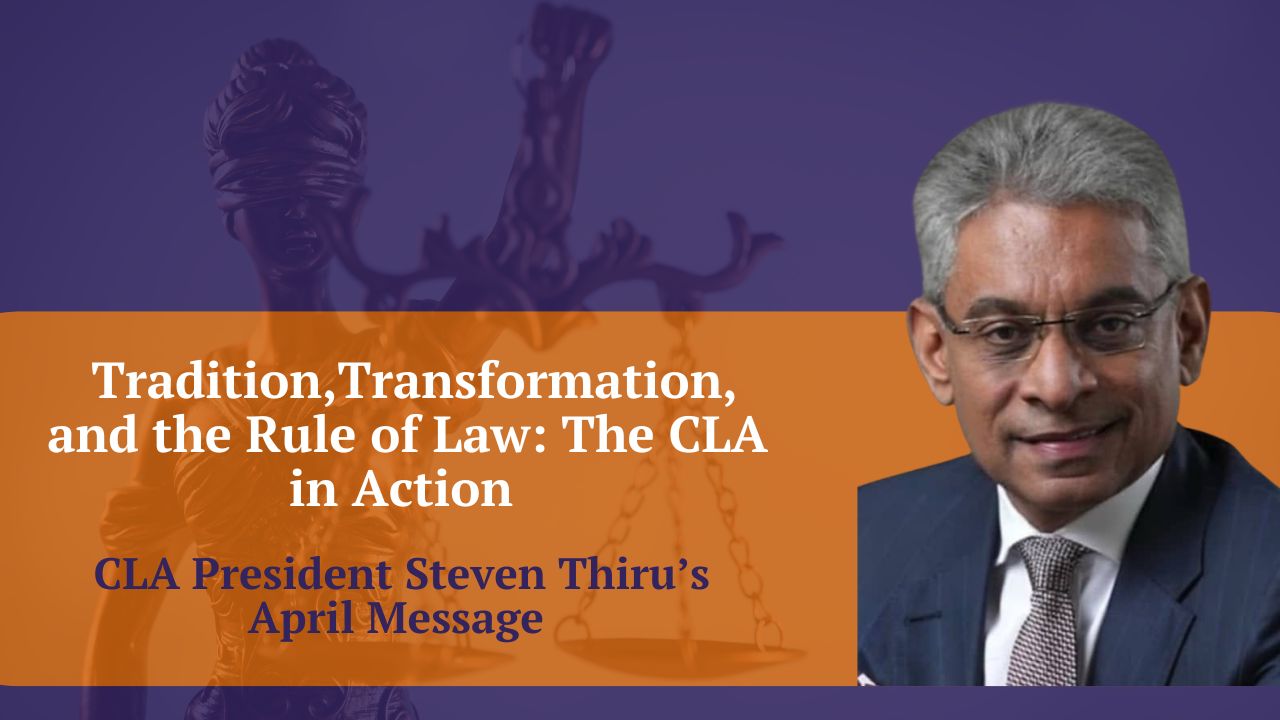
CLA News / President’s Message (April 2026) Tradition, Transformation, and the Rule of Law: The CLA in Action by CLA President Steven Thiru

We recognize that we are the products of many cultures, traditions and memories; that mutual respect allows us to study and learn from other cultures; and that we gain strength by combining the foreign with the familiar.
Kofi Annan, former Secretary-General of the United Nations (Nobel Lecture, Oslo, 10 December 2001)
The Commonwealth Lawyers Association (‘CLA’), drawing upon the diversity of our members from various cultures, traditions, and legal systems, occupies a distinctive position from which it can lead initiatives and embrace innovation. By combining what Kofi Annan termed the “foreign with the familiar”, we are uniquely equipped to respond with agility and foresight to the evolving landscape of legal practice, exemplified today by the rapid ascent of artificial intelligence. It is only by deliberate innovation — through a bold reset and thoughtful reimagining — that the CLA will not only remain relevant but continue to serve as a dynamic force, shaping the future of the profession across the Commonwealth.
The CLA has, over decades, cultivated an extraordinary reservoir of expertise, collegiality, and institutional knowledge. Any meaningful articulation of progress must therefore be firmly anchored in a conscious respect for our history, as I emphasised in my second President’s Message, Honouring our Past, Forging our Future: a Glimpse into 70 Years of the Commonwealth Law Conference , a year ago.
In that reflection, the deliberate cataloguing of past Presidents was far more than ceremonial; it was an intentional act of institutional remembrance. In tracing the lineage of leadership across continents — from Africa to the Americas, Australasia to Europe — the breadth of our identity and the persistence of our resolve are made manifest. In celebrating these leaders, we honour their contributions and offer a living source of inspiration for the generations that follow.
In fulfilling our mandate to uphold the rule of law across the Commonwealth, the CLA has consistently maintained a principled and authoritative voice, ensuring that an independent and effective legal profession serves society as a whole. We are guided by the enduring principles found in seminal frameworks — such as the Harare Declaration 1991, Millbrook Commonwealth Action Programme on the Harare Declaration (1995), Commonwealth (Latimer House) Principles on the Three Branches of Government (2003) and Commonwealth Charter (2013)— which inform our interventions and reinforce our credibility.
In my third President’s Message, Without Fear or Favour: The Independence of the Legal Profession at Risk? , I underscored that the independence of the Bar is not a professional privilege, but a necessary condition for the robust protection of rights and the proper administration of justice. Likewise, in Defending the Rule of Law: Judicial Independence under Threat in June 2025, I brought into sharp focus the mutually reinforcing relationship between an independent Bar and an independent Judiciary, casting the legal profession as both sentinel and first responder whenever the rule of law is imperilled.
Today, as the legal landscape evolves with unprecedented speed and complexity, innovation is no longer optional; it is indispensable. The advent of artificial intelligence and emerging technologies, in particular, is reshaping the contours of legal practice, revolutionising how research is conducted, how services are delivered, and how access to justice can be expanded to previously underserved communities.
In Transforming Legal Practice Through AI: Towards Greater Access to Justice, I highlighted that when harnessed responsibly, artificial intelligence holds the potential to democratise legal knowledge, enhance efficiency, and bridge systemic gaps in access to justice. At the same time, this profound potential imposes a responsibility: vigilance is required to safeguard ethical integrity, professional independence, and the rights of those whom the law is meant to protect.
Beyond technological advancement, the CLA’s commitment to progress is equally evident in our proactive efforts to strengthen the structural protections governing the legal profession. A notable example is our advocacy in support of the Council of Europe Convention for the Protection of the Profession of Lawyer (CETS No. 226), a landmark instrument designed to secure international recognition and protection for the independence and safety of lawyers.
The Convention enshrines safeguards against harassment, intimidation, and improper interference, while affirming the essential role of lawyers in upholding the rule of law. Recognising its significance, the CLA is actively promoting the Convention not only through advocacy but also via institutional partnerships. This is reflected in specific provisions within our Memoranda of Understanding with key partner organisations such as the Supreme Court Bar Association of India (signed on 22 March 2026), and our Joint Declaration with the Union Internationale des Avocats (UIA) (signed on 27 March 2026).
Innovation is equally evidenced in our efforts to address questions of access to justice and equity, exemplified by the Indigenous Lands Rights Project. Grounded in the principles of the 2007 United Nations Declaration on the Rights of Indigenous Peoples, this initiative seeks to identify and recommend best practices in policy and legal frameworks that recognise and give effect to the land rights of Indigenous peoples across selected Commonwealth jurisdictions. By adopting a nuanced legal approach that respects both Indigenous and non-Indigenous systems of law, alongside the customs and traditions that inform them, the Project focuses on whether access to justice is truly genuine and equitable.
As the CLA continues to build upon these initiatives, we remain firmly committed to advancing our mission through collaboration, dialogue, and sustained engagement across the Commonwealth. Preparations for the 25th Commonwealth Law Conference, to be held in Darwin from 9 to 13 May 2027, are progressing apace, promising to serve as a vital forum for exchanging ideas and strengthening professional ties. Likewise, the Africa Legal Forum 2026 convening in Kigali from 28 to 30 October 2026 will provide a pivotal regional platform for addressing pressing legal issues within the African context. These forthcoming gatherings stand as a testament to the CLA’s enduring vitality, and we warmly encourage members and stakeholders alike to engage fully as we collectively shape the future of the legal profession.
The CLA has also embraced substantive institutional reform by introducing the President-Elect position in September 2025, with Sophie Stanbrook elected as the first office-holder. This significant development strengthens the leadership structure and governance within the Association, ensuring stability during a period of transition, mentorship, and strategic continuity between successive office-holders, thereby enhancing informed decision-making at the highest levels.
In an era marked by increasingly alarming violations of international law, the imperative to defend the rule of law has acquired renewed urgency. We must interpret our mandate expansively, responding not only to developments within Commonwealth jurisdictions but also engaging more purposefully with broader international legal challenges that bear upon judicial independence, the protection of fundamental rights, and the ethics of the profession. By adopting this outward-looking and proactive posture, the CLA continues to serve as a credible and influential voice in global legal discourse, reinforcing our role as a steadfast guardian of justice and the rule of law in an ever more complex and interconnected world.
At this intersection of tradition and change, the CLA is called not merely to respond, but to lead — with vision, courage, and unwavering integrity. By honouring our past, upholding the independence of the profession, embracing innovation, and extending the reach of justice, we reaffirm our identity as a force for principled change and a beacon of professional excellence. Let us move forward with clarity of purpose, unity of vision, and a steadfast conviction in the abiding capacity of the law to serve the common good.
Steven Thiru
President
Commonwealth Lawyers Association
28 April 2026
Steven Thiru records his appreciation to Jaishanker Sadananda and Chin Oy Sim for their assistance in preparing this article.
This is an expanded version of an article first published in The Commonwealth Lawyer (Vol 36, No 1, April 2026), available for CLA members to download