

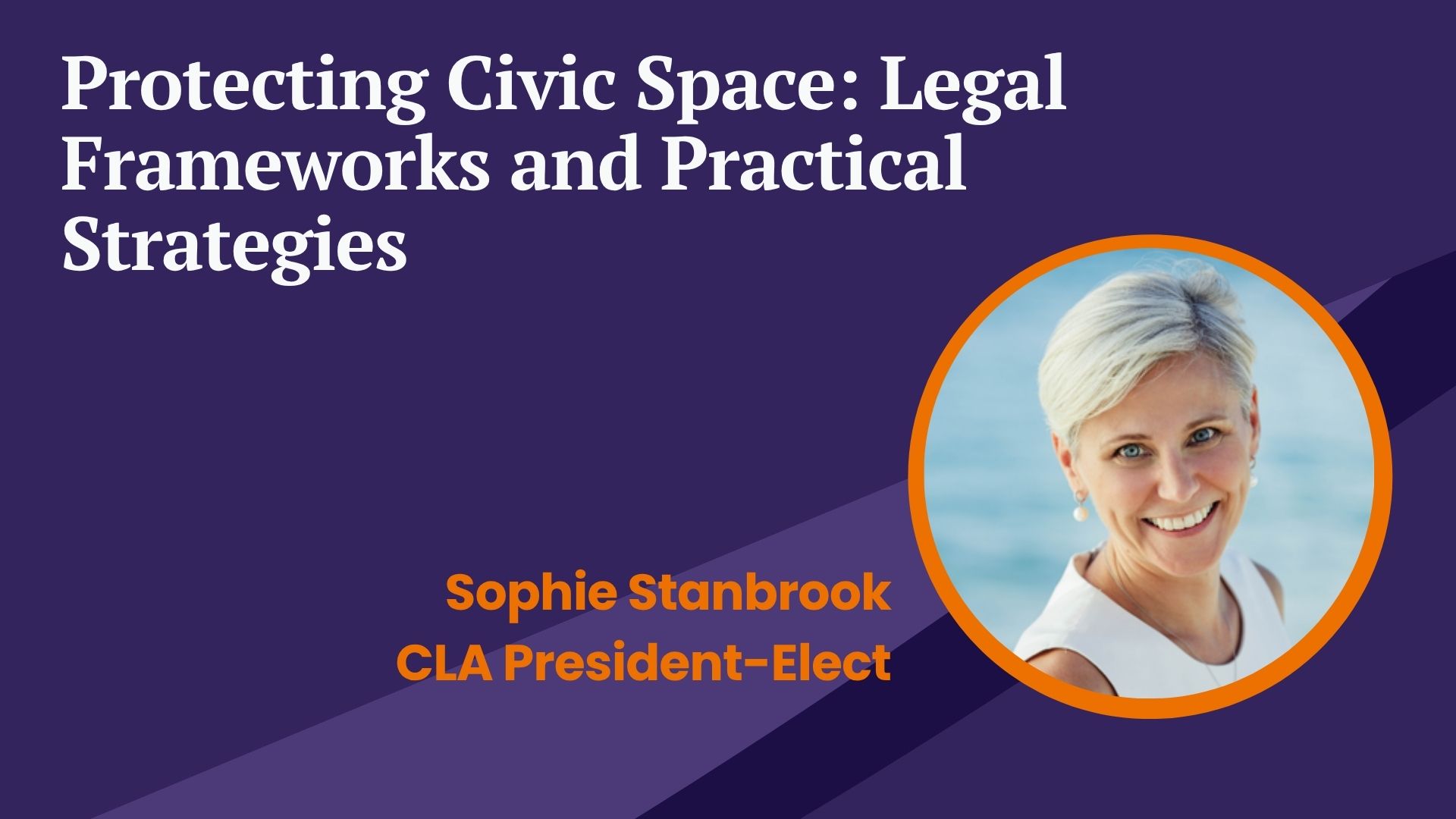
CLA News / Sophie Stanbrook, CLA President-Elect, addresses high-level dialogue on the legal regulation of civic space across the Commonwealth: Protecting Civic Space: Legal Frameworks and Practical Strategies

On 26 March 2026, CLA President-Elect Sophie Stanbrook delivered a presentation for a panel at the Commonwealth Forum of National Human Rights Institutions (CFNHRI) High Level Dialogue in London. She provided a comprehensive overview of the legal and regulatory barriers impacting civic space within Commonwealth nations, and outlined practical strategies for reform.
The Legal Ecosystem of Civic Space
Sophie opened by framing the legal regulation of civic space as “the whole ecosystem of rules and decisions that determines whether people can speak, organise and assemble without fear.” This encompasses not only constitutional protections but also the everyday law of crime and regulation, funding and licensing regimes, and the choices made by police, prosecutors, regulators and courts.
“Think of it as both the architecture and the plumbing of public life,” she explained. “The grand design matters, but so do the joinery and the taps: how offences are drafted, how permits are issued, how long someone can be held before charge, and whether judges have the tools and the inclination to insist on precision and proportionality.”
Common Patterns of Restriction
Drawing on the 170-page report Who Controls the Narrative—produced by CHRI, CJA, CLA and others—Sophie identified a “small family of legal tools” that consistently shape the boundaries of public discourse across the Commonwealth:
- Blasphemy and insult-to-religion laws, which often silence minority views and embolden vigilante behaviour
- Criminal defamation and sedition, where the process itself deters journalists and activists even without conviction
- Cybercrime, “false news” and online safety laws, often framed broadly with sweeping powers that can capture legitimate speech
- Counter-terrorism laws with definitions too wide or powers too heavily concentrated in the executive
- Foreign funding restrictions and NGO registration requirements, presented as transparency measures but capable of making it extremely difficult for independent civil society to function
“The common thread is not where this civic space narrowing happens, but how it happens,” Sophie observed. “New laws are introduced under familiar banners—public safety, cybersecurity, counter-terrorism. Those are all legitimate aims. But without clear definitions and strong judicial safeguards, those laws can quietly expand the state’s ability to regulate not just conduct, but speech and organisation.”
The Cumulative Chilling Effect
Sophie emphasised that the lived result of these restrictions is a chilling effect that rarely announces itself in a single headline. Journalists self-censor because the cost of a complaint is too high. Artists self-edit because the risk of offence becomes criminal rather than reputational. Community groups decline to speak at rallies because their registration or bank account might be at stake. Lawyers think twice before taking briefs that might anger regulators.
“The public square narrows by increments, and the law—its text, its interpretation and its enforcement—has done the narrowing.”
The Importance of Independent Oversight
A central theme of the presentation was the critical role of independent oversight bodies. “Independent oversight is the hinge on which the legal regulation of civic space turns,” Sophie stated, “because it is what separates principled, proportionate safeguards from politically driven controls.”
She noted that for National Human Rights Institutions, Paris Principles compliance—independence of mandate, appointments, tenure and budget—is what enables them to convene government and parliament around evidence-based reform without being co-opted.
Practical Tools for Reform
Sophie highlighted three key resources available to NHRIs and advocates:
- The Commonwealth Principles on Freedom of Expression and the Role of Media in Good Governance, adopted at CHOGM, alongside the Latimer House Principles
- The Who Controls the Narrative report, with its practical action points
- Rights-compatibility mechanisms already implemented in certain Commonwealth jurisdictions
She particularly championed the introduction of mandatory compatibility statements—similar to those required in the United Kingdom—before any national security or public safety legislation is enacted. “This requires the government to set out—publicly—how the proposed law complies with rights standards, particularly legality, necessity and proportionality under the ICCPR,” she explained. “It forces discipline at the drafting stage and creates a clear record for scrutiny.”s
The Role of Regional Collaboration and the CLA
Sophie emphasised that regional collaboration turns these mechanisms into momentum. She outlined how the CLA can work to mobilise bar associations and law societies to:
- Co-draft model clauses and templates for compatibility notes drawing on Commonwealth precedents
- Convene rapid pro bono panels
- Support NHRIs in strategic engagement with parliaments and courts, including amicus briefs that anchor the least-restrictive-means test in domestic doctrine
“These are practical ways to live up to the Latimer House Principles and to defend the independence of the legal profession and judiciary when restrictive laws imperil them,” she concluded.
Looking Forward
Sophie closed with an optimistic message about the potential for positive change: “Civic space lives or dies in the details of law and how it is used. Our task is to change the default by working together, using the tools we already have, and asking governments to honour the standards they have endorsed in spirit and in law.”
The CLA continues to work with CFNHRI, CHRI, ICNL, UNESCO and the Commonwealth Journalists Association on initiatives to protect and expand civic space across the Commonwealth. Members interested in contributing to this work are encouraged to contact the CLA Secretariat.