

CLA News / Report on the Commonwealth Peace Mediation Conference 2026 Jaipur: “Peace Mediation and The Rule of Law”

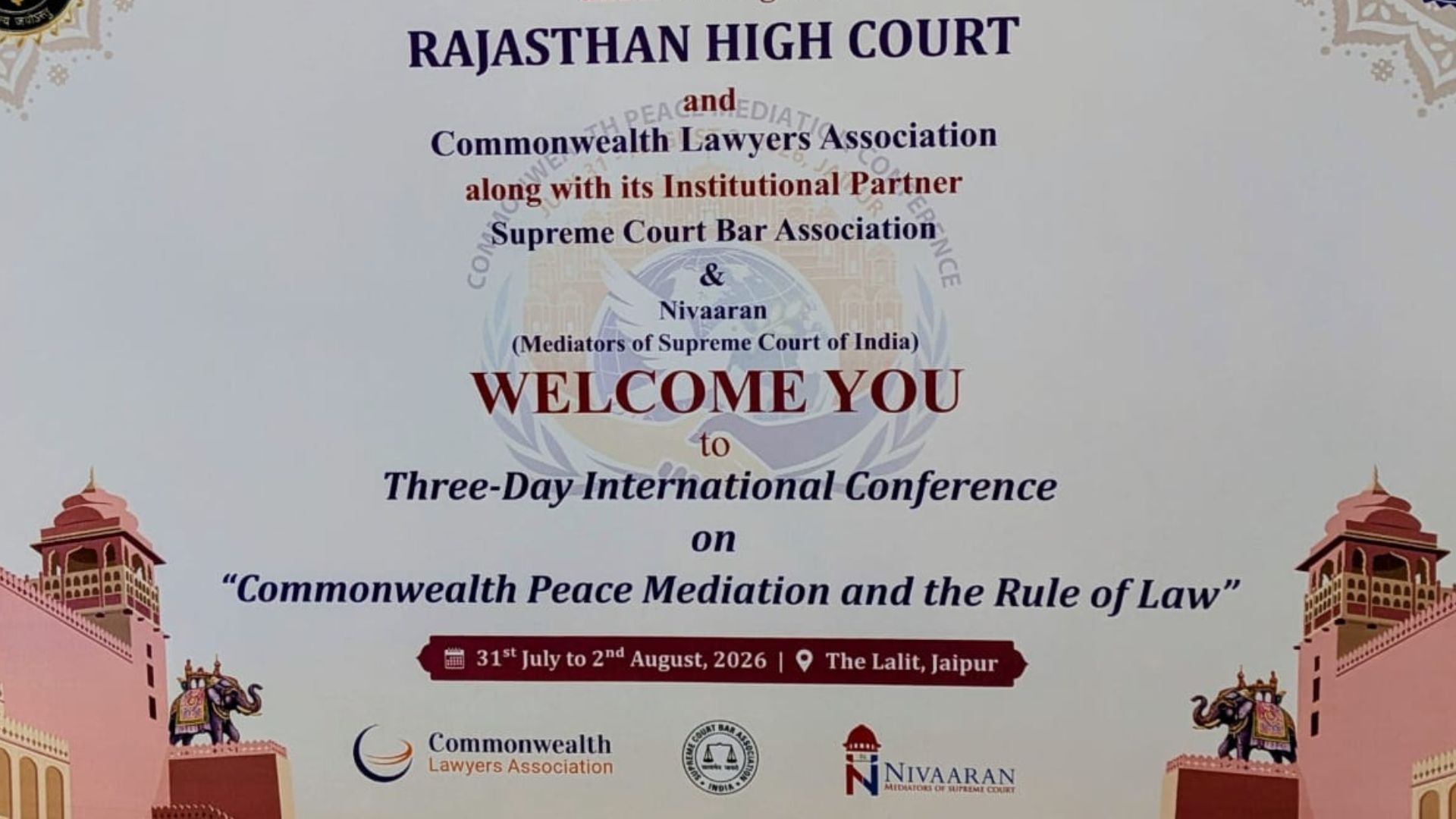
The Commonwealth Peace Mediation Conference 2026 (CPMC 2026), held in Jaipur from 31 July to 2 August 2026, asked a larger institutional question: can mediation become not only a means of settling disputes, but also a method of preventing conflict, preserving relationships, widening access to justice and building durable peace? Judicial, governmental and legal leadership from 11 Commonwealth countries and 15 States across India converged around that proposition. More than 400 participants attended the Opening Ceremony, while the working sessions averaged over 250 delegates. Together, these numbers gave CPMC 2026 both institutional reach and substantive depth.
The Opening Ceremony brought the judiciary, the executive, Law Officers, the Bar and the mediation community onto a common platform. Hon’ble Mr Justice Surya Kant, Chief Justice of India, in his jurisprudential keynote: “Peace is not the absence of law. Peace is one of law’s finest achievements.” Hon’ble Mr Justice Sandeep Mehta, Judge, Supreme Court of India, carried that idea into the professional mindset required for mediation, observing, “Merely thinking as a lawyer, as defence counsel, is perhaps not the right solution to the problem.” Hon’ble Mr Justice Sanjeev Prakash Sharma, Acting Chief Justice of the Rajasthan High Court, located the discussion within constitutional principle: “Peace cannot flourish without justice, and justice cannot endure without the rule of law.”
Government and its Law Officers affirmed that judicial vision into a call for institutional action. Shri Arjun Ram Meghwal described the Mediation Act, 2023 as an institutional commitment to consensus-based justice, while Shri Bhajan Lal Sharma spoke of the aspiration of India becoming a “Mediation Nation.” Mr R. Venkataramani urged deeper institutionalisation with a memorable metaphor: “We need to convert the sleeping mediation law into a majestic elephant.” Mr Tushar Mehta, Solicitor General of India, identified an equally practical reform – empowering government officers, in appropriate cases, “to conciliate rather than contest.”
The Bar’s view can be traced from, Mr Vikas Singh, Senior Advocate and President of the Supreme Court Bar Association, who reduced the access-to-justice challenge to a compelling proposition: “True access to justice must mean access to a resolution.” Mr Aruneshwar Gupta, Senior Advocate and Vice-President of Nivaaran, expressed the larger philosophy of the Conference in a single progression: “The destination of law is justice. The destination of justice is peace.”
The Commonwealth’s voice resonating through, Hon’ble Ms Justice Abha Nayar Patel, Judge of the Supreme Court of Zambia, remarked with characteristic humour, “I don’t know whether my presence on the top table today is a symbol of being a rose amongst the thorns, or the only thorn amongst the roses,” drawing attention to representation within the wider architecture of peace and justice. While emphasising on Mediation she added: “A well-timed act of mediation can restore what litigation alone cannot: relationship, dignity and trust.”
The international structure traversed through in the sessions which followed. The environmental deliberations offered one of the clearest illustrations of why this wider approach integrated in climate and ecological disputes, which are often multi-party, scientifically complex, inter-generational and incapable of being adequately answered by monetary compensation alone. The Conference therefore advanced structured environmental mediation built around stakeholder mapping, joint fact-finding, interim standstill arrangements, interest-based negotiation, transparent outcomes and enforceable settlements. At the same time, an essential boundary was maintained: consensual processes may assist with regulatory compliance, rehabilitation, waste management and inter-agency coordination, but irreversible ecological harm may require authoritative adjudication. Concrete recommendations included an environmental mediation cell associated with the National Green Tribunal, a multidisciplinary panel of specialist “green mediators”, reconsideration of the statutory exclusion affecting environmental mediation, and stronger voluntary compliance standards within polluting industries. Environmental mediation was thus framed not as bargaining over ecological harm, but as collaborative ecological stewardship.
The same philosophy was tested across family conflict, criminal justice, commerce, workplaces and public infrastructure. In family disputes, the central insight was that a legal victory may still amount to a human loss if litigation permanently destroys communication, dignity or inter-generational relationships. Family mediation was therefore approached as a means of protecting continuity and restoring communication, not merely disposing of matrimonial cases. In criminal justice, restorative justice, victim-offender dialogue, plea bargaining and community participation were placed alongside deterrence, suggesting that accountability and restoration need not always be opposing ideas. In commerce, mediation was recognised as business-continuity infrastructure: in cross-border trade and digital transactions, relationships and trust are themselves economic assets. Workplace mediation extended the same reasoning to disputes involving dignity, discrimination, communication and institutional trust. Infrastructure and construction disputes added a public dimension, because delay, cost escalation and stalled projects affect citizens far beyond the contracting parties. Across sectors, one principle repeatedly returned: intervene before disagreement hardens into rupture.
That preventive philosophy produced one of the Conference’s most significant conceptual contributions – the “window of preventability”: the period in which communication is beginning to fail but escalation has not yet become inevitable. Mediation has its greatest preventive value when institutions can recognise and act within that window. Community mediation consequently emerged as a bridge between formal justice and local problem-solving, bringing resolution closer to where conflict begins – in villages, neighbourhoods and local institutions. Yet the Conference also confronted the risks of informal processes in communities marked by inequalities of caste, gender, religion or economic power. Community mediation must therefore remain voluntary, fair, accountable and safeguarded against social coercion. Proposals included trained community mediators, local digital mediation facilities, sensitisation of local leadership and stronger links between community settlements and formal enforcement mechanisms.
From these sectoral discussions emerged a broader jurisprudential proposition: legal systems should not concern themselves only with deciding disputes after they mature; they should also build institutional capacities to de-escalate, restore and prevent. Restorative justice, collaborative lawyering, therapeutic jurisprudence and problem-solving adjudication were considered within this emerging idea of peace jurisprudence. The Conference drew upon dispute-resolution traditions from India, Africa, the Caribbean and other civilisations to show that mediation is not merely a modern procedural innovation, but a recurring civilisational method of sustaining coexistence. Inclusion was integral to that vision, particularly the meaningful participation of women in mediation processes and in the institutions that supervise them. Technology formed another frontier. Artificial intelligence can assist document analysis, conflict mapping and legal comparison, but the proceedings cautioned against permitting efficiency to displace empathy, accountability or human judgment. Technology may strengthen mediation; it cannot replace its human foundations.
The CPMC 2026 forged its International commitment at the Closing Ceremony, Hon’ble Mr Justice Vasheist Kokaram, Judge of the Court of Appeal of The Bahamas, gave that agenda one of its most memorable formulations: “Let us declare Jaipur not only the Pink City, but Jaipur as the Peace City.” His invitation to carry the movement forward to the Caribbean and to the succeeding conference in The Bahamas gave the Jaipur conversation a living continuum. Adding to it, Hon’ble Ms Justice Abha Nayar Patel stated, “Mediation is not the soft alternative to justice. It is justice pursued by patient means.” Hon’ble Mr Justice A.H.M.D. Nawaz, Judge of the Supreme Court of Sri Lanka, stated: “The rules gives us certainty, but Justice is the aspiration of the law, and mediation is the bridge between law and justice.”
Speaking for the host State, Hon’ble Diya Kumari, Deputy Chief Minister of Rajasthan, stated, “The Jaipur Declaration on Peace Mediation has the potential to serve as an important guiding framework for strengthening mediation practices and advancing the shared pursuit of peace, justice and the rule of law across the Commonwealth.” Hon’ble Mr Justice Vikram Nath, Judge of the Supreme Court of India, Executive Chairman of NALSA and Chairman of the Mediation and Conciliation Project Committee, gave the Conference its forward-looking measure of success: “The legacy of this Jaipur conference will not just be measured in today’s knowledge-sharing and ideas, but in tomorrow’s decisions … when someone who sat in this room reaches for dialogue before they reach for a decree.” He further added “Mediation is not merely a tool of the legal system. It is a civilisational tool and ultimately a way of life—one that can build trust within families, communities and institutions.” Mr R. Santhanakrishnan, President of Nivaaran and Honorary Life President of the Commonwealth Lawyers Association, then placed Jaipur within a continuing Commonwealth journey: “We carry the pink with us. We will carry the peace with us. And with a torch in our hands, let us all go to The Bahamas next year.”
The Conference culminated in the Jaipur Declaration on Peace Mediation 2026 – conceived not as a ceremonial text, but as a framework for carrying the Jaipur principles into institutions across the Commonwealth. Jaipur was proposed as a Commonwealth “Peace City” and as a centre for mediation education, training, innovation and capacity-building. The invitation to hold the succeeding conference in The Bahamas gave the initiative a continuing transnational dimension, while the launch of Rajasthan’s NAYAN digital justice platform demonstrated that technological modernisation and human-centred justice can advance together. The rapporteur’s report identified a continuing agenda: development of community mediation frameworks, reform in environmental mediation, responsible governance of artificial intelligence, a proposed peace-jurisprudence framework, and renewed commitment to mediation in furtherance of UN Sustainable Development Goal 16 – Peace, Justice and Strong Institutions – and the Commonwealth Charter. Taken together, CPMC 2026 and the Jaipur Declaration mark a deliberate progression: from dispute resolution to reconciliation; from reconciliation to justice; and from justice to peace. Jaipur therefore did more than host a conference. It advanced a Commonwealth proposition for the future of justice: resolve earlier, reconcile deeper, institutionalise peace.
Authors: Yashika, Keshav & Udhay